Local skies in San Jose were beautiful all day, and spring daytime temperatures made their first real appearance, so it was no surprise we had a big public turnout at the San Jose Astronomical Association's Houge Park in-town public star party last night. However, I had a lot of concern when packing to go, as the clear blue skies were washing due to a high thin opaque layers of clouds encroaching from the west.
Someone counted eleven telescopes. There were a number of refractors, including a very nice 6" AP on a 900 mount, and at least three ten inch Dobs (including mine). The crowd began to show up just at dusk, and I really didn't have the opportunity to walk around and look at the other scopes. Early on, people were fascinated that they could see Venus and Mars. There was also a thin crescent moon. Venus was so low that the moon and Mars were the showpieces. Later though, Saturn would rise and take center stage.
Aside from the local (solar-system) targets, I was showing people views of The Orion Nebula  (M42), the big open cluster M35 and NGC 2392 (aka The Eskimo Nebula) in Gemini. The high clouds persisted, cutting down transparency, but there was still enough detail in all the objects to make it worthwhile. Saturn at times of steady seeing was spectacular - creamy golden with a slit of a gap in the nearly edge-on rings, and subtle banding on the disk of the planet. Mars was OK, but only occasionally gave up much detail - people just liked its color! There were some quite good views of it though through the 6" AP later in the evening.
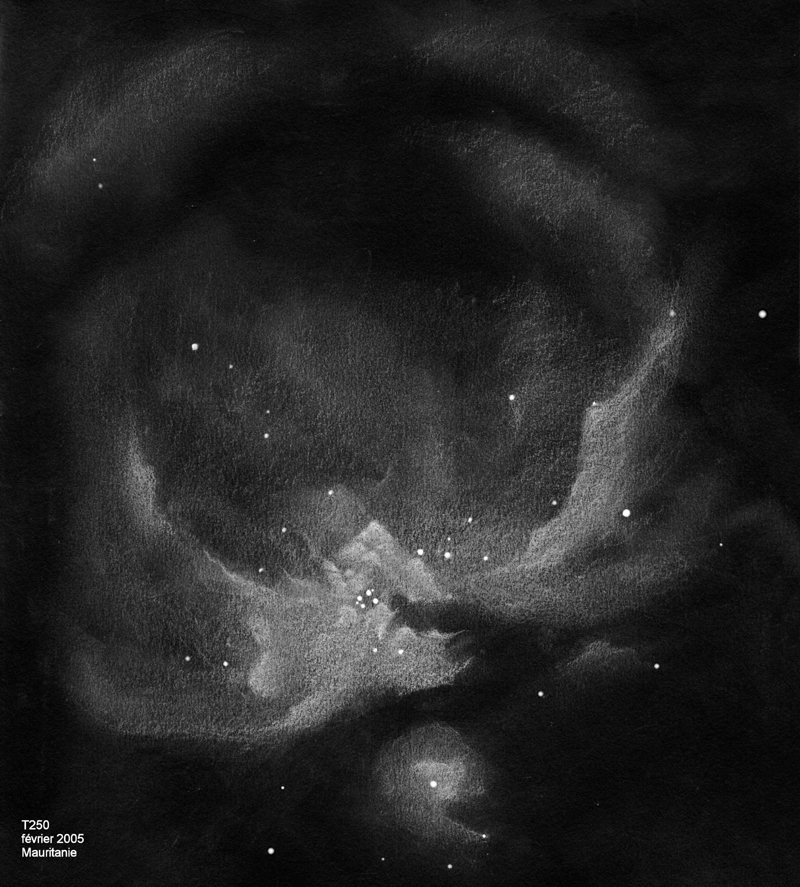 Other than Saturn, the crowd pleaser in my scope was The Orion Nebula. People asked good questions about size and distance, I would answer about light years and what the term meant. Kevin Roberts, set up next to me, interjected with the most tangible comment about the distance, saying the light we're seeing left from the object around the time of the fall of the Roman Empire, before the Dark Ages - good answer! A boy asked how the nebula was formed, so I got to talk a bit about dust and gas in space, gravity, stellar winds and radiation, so aside from the nice visual of the (brighter portion of the ) nebula and Trapezium stars, there was some appreciation cognitively, for what was being viewed. I had added an Orion Ultrablock filter to show more of the nebula - of course it dimmed the stars, but it also led to discussions about passing only certain wavelengths of light. So, all these things led to interesting discussions, and a good size crowd around the scope.
 Overhead, there were long bands of thin clouds that would pass through. Some of them reminded me of the great aurora we saw from Houge Park several years ago. But there was still plenty of decent sky to enjoy. People seemed to like M35, as a contrast in object type to M42. The low power view at 57X allowed nice framing (my scope is a 10" f/5.7)... the stars were varied magnitudes in the cluster, and sharp pinpoints.
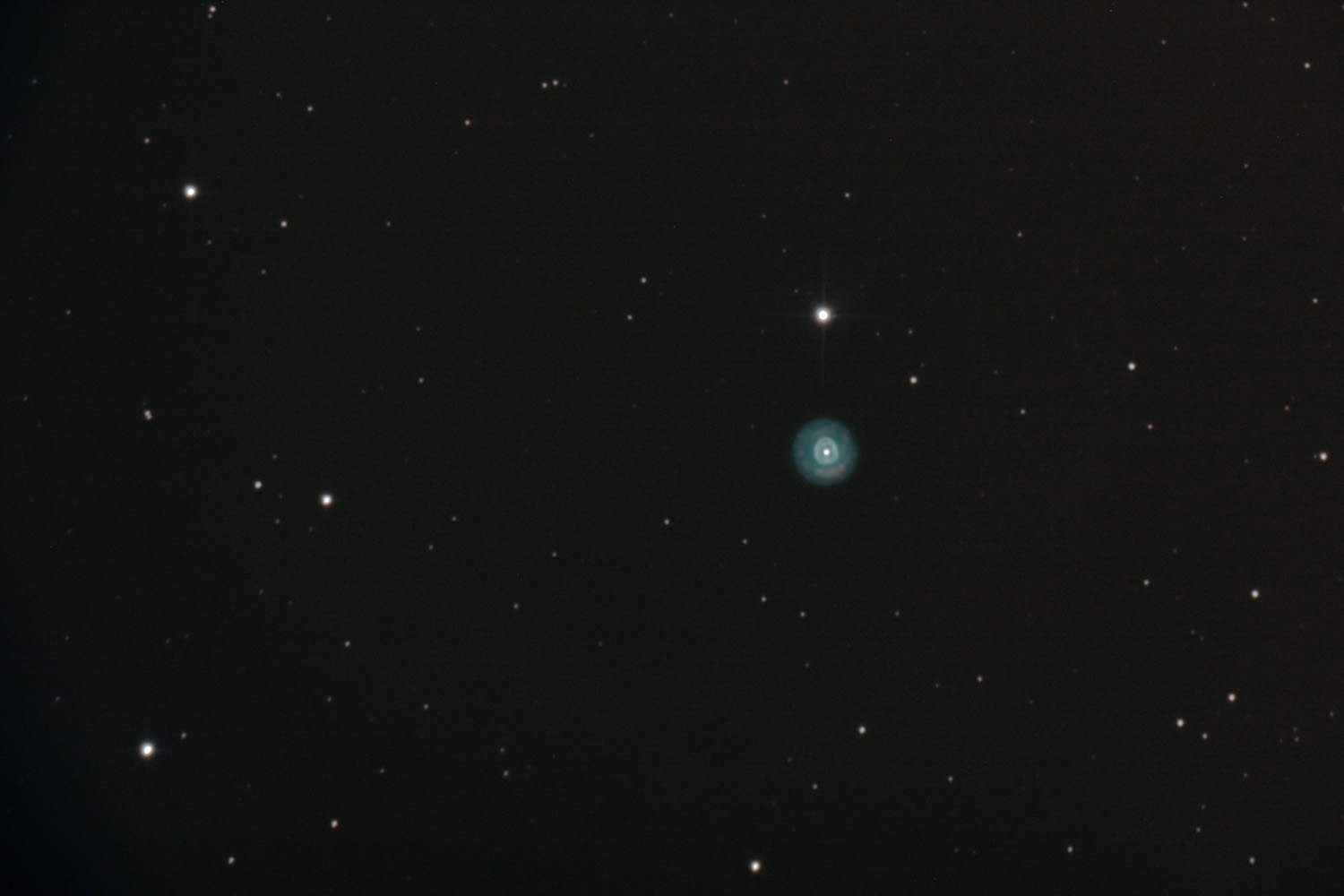 I finished up showing the Eskimo Nebula at 163X. I added an NPB filter, which showed the greatly dimmed central star, round bright disk in which the star is embedded, and a dim outer ring around the disk. Some people saw the object, some saw detail, some could not figure out what I was looking at - it was the "challenge" object of the night!
The last thing I did was to try splitting Procyon, but could easily tell there was enough scintillation to make it impossible. By then it was 11 p.m. the temps had dropped to the point of feeling chilly, and the crowds had disappeared. I packed up while visiting with some old buddies, and new friends I had met during the evening. I got to use my 10" scope, which is a rarity these days, and we had finally had a good (well, reasonable) night at Hogue Park, the first in several months.
A suggestion, if you're not looking at Saturn, you're missing out. It is spectacular right now with the rings at such a shallow angle. Get your gear out and check it out!
Saturday, March 20, 2010
Houge Park's Big Turnout

Sunday, March 14, 2010
The Big Freeze; A Cold Night In UMa
I'm home, and can finally feel all my toes... now to start peeling off the layers of cold weather clothes.
As I stepped out of the garage yesterday, to pile gear in my truck, the north wind blew right through me. A cold shiver had me thinking twice about my decision to drive to Willow Springs. Night temps were forecast around freezing, and this wind... but blue skies won.
Soon I was greeting Richard Navarrete at the meet-up spot in Morgan Hill, where I filled my thermos  with Ethyl, topped off the tank, and headed for the hills. The drive south was easy, quick, and spectacular. The rolling hills were at peak green, wild mustard tall as corn painted the valley floor and spilled on up the sides of the nearby slopes, mixed with orange California Poppies. With podcasts as company, the empty two-lane quickly left the city behind, and led to adventures where the sky is literally the limit. Love the drive, love the place, love the sights, love where it all takes me.
Antelope Valley Road leaves the winding J14 pavement and leads into Willow Springs and Deep Sky Ranch over a one mile series of water-filled pot holes and ruts. I'm always gentle driving in, but enjoy making the morning ride out fun and exciting... Anyway... upon arriving at DSR, I found Steve Gottlieb at the gate and Peter Natscher pulled over to the side of the road. Soon Richard pulled up, to be joined shortly by Julien Lecomte and Rogelio Bernal Andreo. We noted the 42F degree temp, and while setting up chatted about our observing buddy Greg moving to Arizona, DSR regular Marko Johnston bailing on us for an observing trip down under, and the conveniences of DARC Observatory. Our host Kevin Ritschel arrived and the group was complete. Venus was low in the west, with Sirius, Procyon and Mars rising to zenith in a line from the south. Just as I was noticed it, Kevin pointed out the Zodiacal Light, amazingly bright and wide, tilted toward the south, up into Taurus through the Pleaides. There was no hint of dew, and the wind had disappeared. This held the promise of a great night... M42 showed tons of detail even in full twilight. I climbed into the truck to gear-up for the cold, and by the time I got out, the winter Milky Way and hundreds of stars were out...
Early soft seeing would steady up during the night. Peter's plan was to mostly study planetary nebulae on the McNeil 450 list, with his 24" Starmaster. Julien worked on finishing the Herschel  400 with a 12" Meade LightBridge. Richard's 18" Obsession sat on an Osypowski Equatorial Platform, hunting Hicksons until late... Steve... well... he always has something unexpected, and last night his 18" Starmaster was showing Sharpless reflection nebulae, blasars, and other selected esoteric targets, such as the Integral Sign Galaxy. Kevin was testing GoTo on a 12" driven Dob... with gears that were reminiscent of the old Coffee Grinder LX-200's! Me... slumming a list of mixed targets in the chilly north, with my 18". Oh, almost forgot Rogelio... the lone imager! I believe he was shooting the Seagull Nebula, but we'll have to wait and see... it strikes me as ironic, that I, a visual observer who uses little in the way of technology in the hobby, have to describe non-visually in writing what I see, yet Rogelio, who relies heavily on technology, presents us with no words, and instead, something that is entirely visual!
So, during the night, we'd share views, take breaks, drink coffee (regular coffee) and talk... relaxed and friendly, a very good group. I especially enjoyed seeing Peter, who I've known for many years, but rarely get to observe with. During the night, the temps dropped to 26F. I had all my layers on, chemical toe warmers in my Sorrels, fingerless gloves inside mittens with fold back fronts - in which I put toe warmers. By 1 a.m., the cold was enough. I couldn't feel my toes, the soles of my feet were icy, and I couldn't take notes. I closed shop, took off my boots and jacket, and crawled inside the truck, into my sleeping bag, thinking about frostbite, and about freezing...
I woke groggy in the morning to a big freeze outside... a layer of ice covered the green hills and gear, a white world under perfect blue skies.
Now that I'm home, and can finally feel all my toes... despite the temps, and the numbing, I have to say I had a great time. The coffee in my thermos is still hot as I write this.... maybe I just need more insulation.
Here are the targets I observed, in star-hopping order, and some sketchy notes about them... Arp 207 Dra GX 1.2'x0.2' 15.4 09 31 06 +76 27 00 UGC 05050
18" 7mm bright pinpoint core, elongated NW/SE 3x2, about 1'x0.7'. Dim halo. NGC 2985 UMa GX 5.5x5 10.6 09 50 24 +72 17 00
18" 7mm very bright core with a slightly brighter nucleus embedded. Brightness drops off rapidly to a large dim halo, elongated mostly N/S and about 3'x2'. M82 UMA GX 9.x4.0 9.5 09 55 54 +69 41 00 NGC 3034 Arp 337
18" 7mm very bright and mottled with dark intrusions near center of 8.5'x2.5' elongation, WSW/ENE. HII regions to E of center near crossing dark lane. With UHC, 3 obvious HII regions, two adjacent to dark intrusion, one to W and possibly one more at extreme W end. NGC 2787 UMa GX 2x1.3 10.9 09 19 18 +69 12 00
18" 7mm large spiral NNW/ESE with large dim halo showing hints of spiral structure. Core is bright, small, and shows chaotic form, or perhaps very tightly wound spiral arms in the core. Approx 3'x2'. M81 UMA GX 21.0x10.0 8.5 09 55 36 +69 04 00 NGC 3031
18" 12mm beautiful tight bright small core gradually decreasing in brightness along a mostly NW/SE elongation of about 20', with 10' width. Tenuous spiral arms distinctly evident on the SE edge, leading around E to NE. Spectacular galaxy, much in the way 47 Tucanae is for globulars. Dim spiral arm is also visible extending from NW and around the W side, separated widely by large black dark lane. NGC 3077 UMa GX 2.3x1.9 10.9 10 03 18 +68 44 00
18" 7mm tiny dim pinpoint nucleus surrounded by a moderately bright 0.5' core that is mostly round but rather chaotic. Larger dim envelope seems to extend more to the E of the core, and about 2'x1.5' E/W Arp 300 Uma GX 1.6'x1.0' 13.4 09 28 02 +68 25 00 UGC 05029
18" 7mm pair of galaxies oriented mostly E/W and close together, W is brighter and smaller, elongated mostly N/S, E galaxy is larger, more diffuse and more NE/SW elongation. NGC 2976 UMa OC 10 8.5 09 47 12 +67 55 00
18" 7mm elongated 6'x2' with even brightness across entire galaxy. Very slight hint of small brighter core, or possibly HII embedded. Mottled. Bright. Elongated N/S. N2814/20/I2458 UMa Trio 3.9 13.7:12.8:15.0 09 21 48 +64 18 00
18" 7mm - wonderful view of 3 edge on galaxies. Largest is E of the smaller two, elongated 3'x0.2' NW/SE, other two are almost perpendicular to largest at N/S, at 0.5'x0.1'. Larger galaxy nearby clearly visible. NGCs 2820, 2814 and IC 2458. NGC 2805 very nearby. N 2805 UMa GX 6.3x4.8 11 09 20 20 +64 06 10
18" 7mm - large and clumpy. Dim, core shows best. At first appears core only, but soon lumps appear out away from core…. Arms? HII regions?' N 2880 UMa GX 2.0x1.2 11.5 09 29 34 +62 29 27
18" 7mm small bright core with stellar nuclei, dim large extended disk mostly N/S at 2'x1'. Active galaxy? NGC 2742 UMa GX 2.5x1 11.2 09 07 36 +60 29 00
18" 7mm elongated 4'x2.5', even brightness, mottled, E/W, perhaps a very faint stellar nucleus. NGC 2768 UMa GX 2x1 10.5 09 11 36 +60 02 00
18" 12mm - stellar nucleus surrounded by a small bright elongated core. Elongated disk runs WNW/ESE about 3'x1.8' NW/SE.. Beautiful galaxy! NGC 2950 UMa GX 1.3x.9 10.9 09 40 36 +58 51 00
18" 7mm - elongated galaxy WNW/ESE 2'x1'. Bright pinpoint nucleus in a small bright core that ends abruptly. NGC 3079 UMa GX 8x1 11.2 10 02 00 +55 41 00
18" 7mm elongated N/S 7'x1', S 3' is brighter and mottled, and warped to W. Nice! NGC 2841 UMa GX 6.4x2.4 9.3 09 22 00 +50 58 00
18" 7mm elongated 4'x2; mostly N/S with small bright core and dim stellar nucleus, dusty mottled appearance. N2854/56/57 UMa Trio 10.6 13.0:13.1:12.3 09 24 30 +49 18 00 NGC 2857 = Arp 1 NGC 2854 = Arp 285
18" 7mm 2854 and 2856 are very similar small bright elongated galaxies, perpendicular to each other. 2857 is large, dim and diffuse. HCG 041 UMA Hickson 1.5x0.3 13.6 09 57 35 +45 13 48 UGC 05345
18" 7mm 2 bright ones show. End of notes. Freezing. No toes, no fingers. Bed time.
California Poppy image by Steve Loos...
Wednesday, February 17, 2010
A Good Night For Winter
Getting out twice in a week, observing, is a rarity. Having had modest success at Dinosaur Point on Saturday night, when the weather forecast showed a good opportunity on Tuesday, four TACos jumped on it and met at Willow Springs. The rationale was simple. One, it could rain for the next two months. Two, the satellite imagery was favorable, even though skies at 3:30 p.m. were mucky and not encouraging. I had a running conversation with Richard Navarrete during the afternoon, and it came down to this simple statement: "I'd hate to go and get skunked, but I'd hate worse not going and hearing it was a good night".
Our arrival was after dark, but within 45 minutes, including some equipment repair (Richard's equatorial platform battery was dead), we were underway.
I have to say, the drive to Willow in the dark is a different animal than I'm accustomed to dealing with. Driving south through Gilroy, then Hollister, is typical night "city" driving. But once I passed through the hamlet of Tres Pinos, it felt like I was on a road to nowhere. Twists, turns, occasional oncoming headlights... it was as if the road was a ribbon of safety and nothing else existed. I listened to an astronomy podcast about advanced civilizations, and learned about theorized Dyson Spheres, as I arrived.
Things worked out quite well. There was dewing, but it was minimal. The sky cleared, I was hearing SQM reading in the mid 21's. Decent transparency... not the best, but workable. I think the highlights of the night were seeing Greg LaFlamme again, before his departure to Arizona, enjoying some of Marko Johnston's humor, watching our host Kevin Ritschel buzz around toying with a 12" Synta driven Dob, and looking at views of some tough Hickson Clusters of Galaxies with Richard. Greg had one of the bet views of The Ghost Of Jupiter in his scope I've ever seen. I need more power! Also, and this is always one of the most mesmerizing things to look at when you get a great view, M51 was stunning. A view like that is what makes people look in wonder, realizing what they are seeing is real, and mindlessly far away, even though it is a "close" object. Mind numbing, mind expanding...
I suppose we were at it until about 2 a.m., when I laid down in my sleeping bag, and watched as, "overhead, without any fuss, the stars were going out."


We were all glad to have had the opportunity to observe, and enjoy each others comradarie and company.
back to the daily routine, and life on planet earth.

All above shots are done via iPhone. Wish I could say the same for those below!
Here are my observing notes...
Equipment was an 18" f/4.5 undriven Dobsonian, and three Nagler eyepieces, 20mm, 12mm and 7mm, Rigel Quickfinder, and The Sky planetarium software (as a chart). The only filter I used was an NPB.
 N 2541 Lyn GX 6.3x3.2 11.8 08 14 40 +49 03 43
20mm 18" - large, elongated 4x2 NW/SE, no core, gradually brightening to the center.
 Arp 6 GX 1.7'x1.5' 12.3 08 13 14 +45 59 00 NGC 2537
12mm 18" - small, mostly round with slight elongation NW/SE, bright, no discernible core, bright throughout. IC2233 in same field, with 7mm long dim slash 6x1 N/S with star embedded in N end.
 N 2493 Lyn GX 1.9x1.9 12 08 00 23 +39 49 49
7mm - 18" - small, very bright core with stellar nucleus, dimmer outer halo extended 3x2 SW/NE. N2495 and CGCG 207-17 both visible to NE.
 Arp 143 GX 1.2'x0.8' 13.2 07 46 53 +39 01 00 NGC 2444 and NGC 2445
7mm - 18" - almost identical galaxies, N/S, dim halos each with bright stellar cores. Galaxy to N is a bit brighter. Both small in angular size.
 NGC 2419 Lyx GC 1.7 11.5 07 38 60 +38 53 00
7mm - 18" - mottled but bright globular, averted gives hints of resolution. This object is the farthest globular cluster from us, in our own galaxy.
 N 2415 Lyn GX 0.9x0.9 12.4 07 36 56 +35 14 32
7mm 18" - small round galaxy with moderately bright core, no nucleus, dim halo.
 N2373/75/79 Gem Trio 10.1 13.7:13.6:13.5 07 27 24 +33 48 00
7mm 18" - all three show with averted vision. Pair are mostly N/S, took work before they started to show.
 N2385/88/89 Gem Trio 7.7 14.2:13.7:12.9 07 29 06 +33 48 00
20mm 18" - all three show up easily. 7mm shows all three have stellar nuclei, and appear elongated N/S.
 NGC 2372 NGC 2371 Gem PN 47x43 9.5 07 25 36 +29 30 00
7mm 18" - nice bi-lobed proto-planetary with pinpoint progenitor star obvious. Both lobes bright, W lobe is brighter and more condensed, E lobe appears larger but dimmer. E lobe aslo has bright condensed center. Appears there is a larger dim oval envelope surrounding entire object. W lobe has a blue-green tint, without filters.
 Arp 82 GX 2.5'x1.2' 12.8 08 11 13 +25 12 00 NGC 2535 NGC 2536
12mm 18" - dimmer member of pair is SE of larger and brighter one. Larger member appears elongated N/S, dimmer has tiny stellar core and is perhaps linear inside envelope.
 NGC 2420 Gem OC 7 10.2 07 38 24 +21 34 00
12mm 18" - horseshoe of bright stars opening to W, with a tail of stars off the SE end of the closed part of the horseshoe. About 8 stars in the horseshoe, with 4 in the arced tail, opening to the W. Many dim stars fill in and through the brighter components. Very obvious cluster, elongated E/W. CGCG 1117-59 and 60 show up barely as dim elongated smudges with 7mm.
 NGC 2392 Gem PN 47x43 9.35 07 29 12 +20 55 00
7mm 18" - bright pinpoint central star is surrounded by a very tight black ring, with a brightish second ring that is mottled and elongated slightly N/S. Outside is a large dimmer ring that is uneven in brightness, perhaps just some mottling. Good view. No color. Photo credit NASA
 Arp 165 GX 1.8' 12.2 07 36 37 +17 53 00 NGC 2418
7mm 18'" - very small with a condensed core, stellar nucleus, elongation seems to vary with averted vision, NW/SE, but changes, so may be disrupted.
 Abell 21 Gem PN 744"x509" 10.2 07 29 02 +13 15 13 PK 205+14.1 = PN G205.1+14.2 = YM 29 = Sh 2-274 = Medusa Nebula
20mm 18" - large, dim, using NPB filter. 12mm - elongated NNW/SSE and mottled, almost a dark ring inside the border, with an uneven edge to the entire outer area. Easy target. Photo credit NASA
 N2510/11/13 CMi Trio 5.6 13.4:14.1:11.6 08 02 30 +09 24 00
7mm 18" - NGCs all show, although sky is not good in this direction. 2513 is faint but obvious, other pair are very faint indistinct small smudges.
All four of the next targets are unconfirmed, although the first is pretty assured. I include them only as impressions, what I felt I was catching glimpses of. The mind is a funny thing when looking for threshold targets.
 Abell 24 CMi PN 265"x180" 13.9 07 51 37 +03 00 21 PK 217+14.1 = PN G217.1+14.7
12mm 18" - large, no filter, elongated N/S, central star dim but obvious, stars embedded throughout, but bright ones on S edge. Mottled, brighter eastern edge. Photo credit Martin Germano
 Abell 22 CMi PN 105"x68" 07 36 07 +02 42 28 PK 215+11.1 = K 1-11 = PN G215.6+11.1
12mm 18" - NPB, large oval elongated NNE/SSW, very indistinct, perhaps a bit of brightening on NE and E edge. Hint of annularity. Photo credit Stathis Kafalis
 Abell 20 CMi PN 65" 14.7 07 22 57 +01 45 37 PK 214+7.1 = PN G214.9+07.8
12mm 18" - NPB, medium sized and very dim, round with possible N/S slight elongation, even brightness across object, maybe central star with other stars involved on N and S edges - inside edges. Photo credit Stathis Kafalis
 Abell 25 Mon PN 150"x145" 08 06 46 -02 52 35 PK 224+15.1 = K 1-13 = PN G224.3+15.3
12mm 18" - NPB, elongated a bit N/S, even brightness across, central star, sharp edge especially along NE edge or along entire E side. Star is either central,or on N edge, hard to tell. Photo credit Stathis Kafalis
 M048 HYD OC 54 5.5 08 13 48 -05 48 00 NGC 2548
20mm 18" - large, bright, coarse, dispersed. Lots of chains.


 Posts
Posts