Sunday, April 22, 2012

The Whirlpool's Coils


 A short report from DARC Observatory last night.  DARC is a private property, southeast of the San Francisco bay area, located near Mercy Hot Springs in Little Panoche Valley.  It is dark, remote and desolate.
  
Below are objects I observed (and tried to observe) with my 18" f/4.5 Dobsonian.  All eyepieces are type II Naglers.  Conditions at DARC could not have been better.  Temperatures must have been in the high 80's at 7pm when I arrived.  During the night, there was no more than the slightest breeze - enough to just help cool us down, as we could have been in t-shirts all night long.


 I began by observing NGC 2903, and Ariana Bernal Adreo came over asking to see something in my telescope.  She suggested Venus, but being the Klieg Light that it is, I suggested something less jarring.  So, we went on a little tour.  I began with Saturn, which was nice, but a bit soft.  Then I progressed out to M3, explaining to Ariana that it was still part of our galaxy.  She liked the globular.    Wondering what to show her next, I asked my observing buddy Richard Navarrete for suggestions.  The Whirlpool!  Well placed, it showed great detail.  Ariana easily understood that she was seeing spiral arms.  I suppose some knowledge has rubbed off from her dad.  So, after two galaxies, what else?  Richard?  Ah - the Leo Triplet!  In my 20 Nagler, they sat around the edge of the field.  But Ariana was able to pick them out.  Three galaxies are certainly better than two!  Ten years old, and observing through a big scope - this sounds so familiar to me!  From there, I moved to M84 and M86, the heart of the Virgo Cluster - and asked Ariana to count the galaxies in view - well - four.  Four galaxies in a single view!  Astronishing!  So, I told Ariana about Markarian's Chain, and suggested she tell her dad what she'd seen.  Later, Rogelio came by, and told me these were the first objects his daughter has seen in telescope, that are outside our galaxy.
 
 I was soon back on my program.  In order to just take it easy, I had copied the Spring Favorites from the Adventures In Deep Space web-page:  http://www.astronomy-mall.com/Adventures.In.Deep.Space/spring.htm
 
I took my time, relaxed, and thoroughly enjoyed myself.  I think the most interesting "find" for me was the Eight Burst Nebula - it is so far south, I knew none of the star patterns, and there was enough extinction down low that I found myself guessing at where it might be.  After a lot of looking, and scratching my head, I pointed the scope at the horizon, and .... surprise!.... there it was.  I had to hold the front of the scope down in order to see it.  Also very rewarding were the two galaxy clusters, NGC 3158 and 3166.  I hit my mag limit for the night on MCG+7-21-7, which was at the extreme limit of visibility.
 
In the morning, I woke, and while packing up, lifted my equatorial platform, and found, nicely coiled like The Whirlpool Galaxy, a baby rattlesnake - who was sleeping in the shade of my gear, on this already hot April morning.  I didn't need a cup of coffee, after that....

Thanks to Rogelio Bernal Andreo and Lee Hoglan for hosting our group.  It was an excellent outing, start to finish - a wonderful two hour drive from the Santa Cruz area, out of the domain of man, and I was seeing things, in the dark,  through a telescope (made of glass and wood) - half a billion light years away,   What perspective.


NGC     NAME     TYPE     CON     RA     DEC     VMAG     URA2      

NGC 2903  na     G    LEO     932  2130  8.9 

12mm - bright and elongated 3x2 with strong central condensation across most of the major axis.  Very strong small elongated core that appears round with ansae.  Condensation in arms shows well (NGC 2905).      


Hickson 40  GAL GR  HYA  939    -451 12.8   
 

7mm - 4 members are obvious, 5th does not show up.  Three brightest all have pinpoint bright stellar nuclei, dimmest member does not.  All members are elongated and at divergent angles to each other.     


Double Quasar    QSO     UMA     1001     5541     16.5   
Negative observation.


NGC 3115 Spindle  G  SEX   1005  -743  8.9 

12mm - very bright extremely compact core.  Arms are very thin and very long.  Stellar nucleus is noticeable inside small but elongated core.  Arms ratio fo at least 10x1, and bright.  Highlight object.     
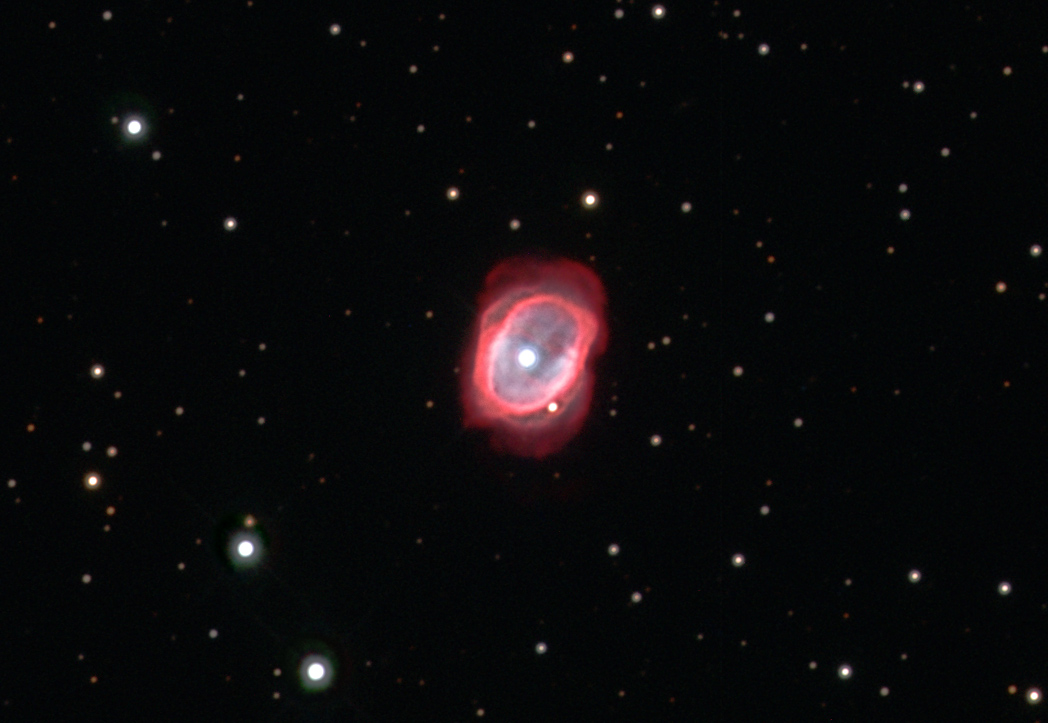


NGC 3132 8-Burst  PN VEL 1007  -4026 9.2 

7mm - large and bright nebula with bright cental star.  Slightly elongated, with a large number of "stars embedded.     


NGC 3158  GAL GR LMI 013  3846  11.8
 
7mm - 11 galaxies in close proximity in view - most challenging MCG+7-21-25 and MCG +7-21-27 both on edge of perception.  NGC 3163, 3161, 3159 form a nice compact chain with MCG+7-21-19 at the W end.  Off further west were NGCs 3151 and 3150.  N was NGC 3158 - the most obvious and largest in the group, with NGCs 3160 and 3152 to its north.  Very nice compact group of galaxies.     


NGC 3166   G  SEX  1014  326   10.4

7mm - NGC 3169 appears disrupted with a bright core that is elongated mostly e/w, and a quickly and randomly diffusing halo.  NGC 3166 lies 15' to its w and has a compact non-stellar core elongated slightly e/w, with a diffuse halo slightly elongated in the same direction.  8' to the west of 3166 and past two dim stars is a non-descript faint glow barely visible, without distinct elongation or direction.  Continuing approximately 30' SW is NGC 3156, a moderately bright galaxy with indistinct shape, a brighter compact large core and a feeling of a disrupted portion extending south.


Hickson 44 GAL GR LEO 1018     2150     11

20mm - beautiful grouping of four obvious galaxies - three in a line, forth close by to the nw of the middle member of the linear group.

Sunday, August 28, 2011

Pole Dancers

Now that I have your attention....

A few days ago, I mentioned on a public observing forum that I was wondering what to observe next. My observing partner, Steve Gottlieb, immediately chirped "how about 25 galaxies within 10 degrees of Polaris". I remembered him mentioning such a project a month back, and learned that in fact he had observed this list very recently at Sierra Buttes, at 7200 feet elevation in the Sierra Nevada. So, I took up the challenge, and last night at Willow Springs I attempted the list. While Willow is only 2200 feet elevation, lacking the transparency benefits the Buttes has, it is a still a very good "local" sight, a mere 2 hours from my home in the south San Francisco bay area.

A few words about the vagaries of this particular weekend - several of us were going to head to a friend's property near Yosemite to observe. The morning we were to leave, the weather forecast showed poor condition - potential thunderstorms, bad seeing and transparency.... we were unsure... weather reports are not always reliable. Then, as I was packing, I got a text message asking what I knew about the fire near Yosemite. Turned out, our destination was under evacuation warning, and choking in smoke. The ONLY fire in the entire state of California! Change of plans. We headed to Willow. Arriving there, the sky was filled with....


smoke.

From a new nearby fire!

Well, it was put out, and the sky cleared nicely. We enjoyed a fine evening observing, but it just goes to show, sometimes you just dodge a bullet ... and get lucky.

So, the Pole Dancers. 21 galaxies Steve sent me in list form. Actually, in an article, but I'll leave the specifics of that to him to discuss. The galaxies were all within 5 degrees of Polaris, and varied from dancers you couldn't take your eyes off of, to those you barely knew were there, or cared. Of the 21, I had 19 confirmed, the remaining two were "suspected" at best - UGC 3661 and CGCG 363-039.

I have to also note, I observe with an 18" f/4.5 Obsession, made in 1994. The mirror has its original coatings, and the only thing I've added is an Equatorial Platform, made by the master, Tom Osypowski. I love tracking, it makes the experience much more relaxed, and I feel I see much more not having to constantly worry about moving the scope at high power (note some of the eyepieces I use in this report). But, observing these targets, so close to the pole, I was able to turn off the drive, and just let the happy circumstance of being very close to the pole do the job of keeping my targets in the field of view. And.... I also never used my ladder, or moved my obseving chair. I could get used to watching pole dancing! ;-)

Finally, another great parts of a trip like this - with experienced and accomplished observers (included Mark Johnston and Richard Navarrete) - - - is sharing views. I've listed a few here in my report.

Thanks to Kevin Ritschel for hosting us at his property, great to see him again.... and thanks to Steve, for the project!

Here are my notes on the 21 Pole Dancers.

NGC 2268" 07 14 17.6 84 22 57 V = 11.5; Size 3.2'x2.0'; Surf Br = 13.4; PA = 63d

18" 7mm Obvious large elongated core in a slightly elongated e/w disk. Pinpoint nucleus comes can be held.. About 2'x1', fairly even gradual dimming from core to edges.


UGC 3528A = Arp 96 07 02 27.4 86 34 46 Size 0.8'x0.6'; PA = 63d

18" 7mm very dime pair with not much detail. Very close together, both have clear pinpoint nuclei, one closer to bright star has brighter obvious stellar nucleus. Both have indistinct hazy roundish disks. With 2x Barlow and 7mm, further out galaxy disk is bigger, brighter, and elongated N/S. Other galaxy disk is smaller, dimmer, and roundish.


UGC 3536A = Arp 96 07 03 22.0 86 33 28 V = 13.6; Size 0.7'x.0.6'; Surf Br = 12.7

18" 7mm very dime pair with not much detail. Very close together, both have clear pinpoint nuclei, one closer to bright star has brighter obvious stellar nucleus. Both have indistinct hazy roundish disks. With 2x Barlow and 7mm, further out galaxy disk is bigger, brighter, and elongated N/S. Other galaxy disk is smaller, dimmer, and roundish.


CGCG 362-033 = PGC 20191 07 08 15.1 86 39 29 Size 0.8'x0.3'; PA = 109d

18" 7mm w/2x Barlow - elongated SE/NW and 3x1 ratio. Inner 1x1 section is fairly even brightness, then falls off at extensions.


UGC 3654 = PGC 20601 07 17 47.1 85 42 48 V = 14.3; Size 0.4'x0.3'; Surf Br = 11.8; PA = 17d

18" 7mm w/2x Barlow - very small and nearly round, but slightly elongated. Dim stellar nucleus, elongation is N/S.


UGC 3661 = PGC 20655 07 19 45.0 85 46 01 Size 1.1'x0.25'; PA = 12d

18" 7mm w/2x Barlow - very fleeting view of just a small section of this thin galaxy.


UGC 3670 = PGC 20677 07 20 04.7 85 35 14 Size 1.0'x0.5'; PA = 40d

18" 4mm - very dim, elongated, even brightness, E/W elongation of about 3x1.


NGC 2276 = Arp 25 07 27 14.4 85 45 16 V = 11.4; Size 2.8'x2.7'; Surf Br = 13.5; PA = 20d

18" 7mm - fairly bright and obvious, compared to others this session. Round, fairly even brightness, mostly featureless except for small slightly brighter round core and dimmest of averted vision pinpoint nucleus.


NGC 2300 = Arp 114 07 32 20.0 85 42 32 V = 11.0; Size 2.8'x2.0'; Surf Br = 12.8; PA = 80d

18" 4mm - very bright very tight inner core with no discernible nucleus, and chaotic appearance. Quickly gives way to significantly dimmer outer core that extends at least three diameters of the inner core in diameter. Outer core extends over 1/2 way to brightest close star to the W. Possible HII to the SW. More possible HII toward pair of stars pointing away to the NNE.


sh2-71 nice detail! Viewed this in Steve Gottlieb's 18" Dob. With an OIII filter, much of the detail shown in this image was visible. The central star was very evident. Without the filter, the object took on a distinctly circular shape, was much less obvious - looked like an Abell Planetary, with an obvious central star. A very interesting object!


MCG 04-029 = PGC 21210 07 32 25.9 86 40 00 V = 14.3; Size 1.2'x0.6'; Surf Br = 13.8; PA = 45d

18" picked up with 12mm, off the end of a chain of four brighter stars framed at the target end by three collinear dimmer stars. Easy fin. Galaxy is small and elongated. The fact that the two collinear chains point into the field, make this a visually pleasing view with the galaxy as a highlight. Chains of stars are E/W, galaxy is mostly N/S, and seems to have brighter central section, and a bright knot to the S. Elongation is N/S.


IC 455 07 34 57.7 85 32 14 V = 13.3; Size 1.1'x0.7'; Surf Br = 12.9; PA = 82d

18" 7mm - picked up easily in 20mm, galaxy has a bright core and inner disk with apparent spiral arms extending


CGCG 362-045 = PGC 21817 07 48 01.0 85 33 07 Size 0.8'x0.6'; PA = 64d

18" 4mm - nice tight small core that appear chaotic. Occasionally a tiny bright pinpoint stellar nucleus appears. From core two close arms appear to extend only slightly, then a a larger disk that shows easily only on the side to S.


UGC 3993 = PGC 22202 07 55 44.0 84 55 35 V = 12.8; Size 1.6'x1.2'; Surf Br = 13.4; PA = 35d

18" 7mm- showed up at that magnification close to a tight uneven double star. Appears chaotic in its bright core..Entire core area is larger than first appeared, and even more disrupted - a dark intrusion? Surrounding is a large dim disk, more noticeable on the double star side.


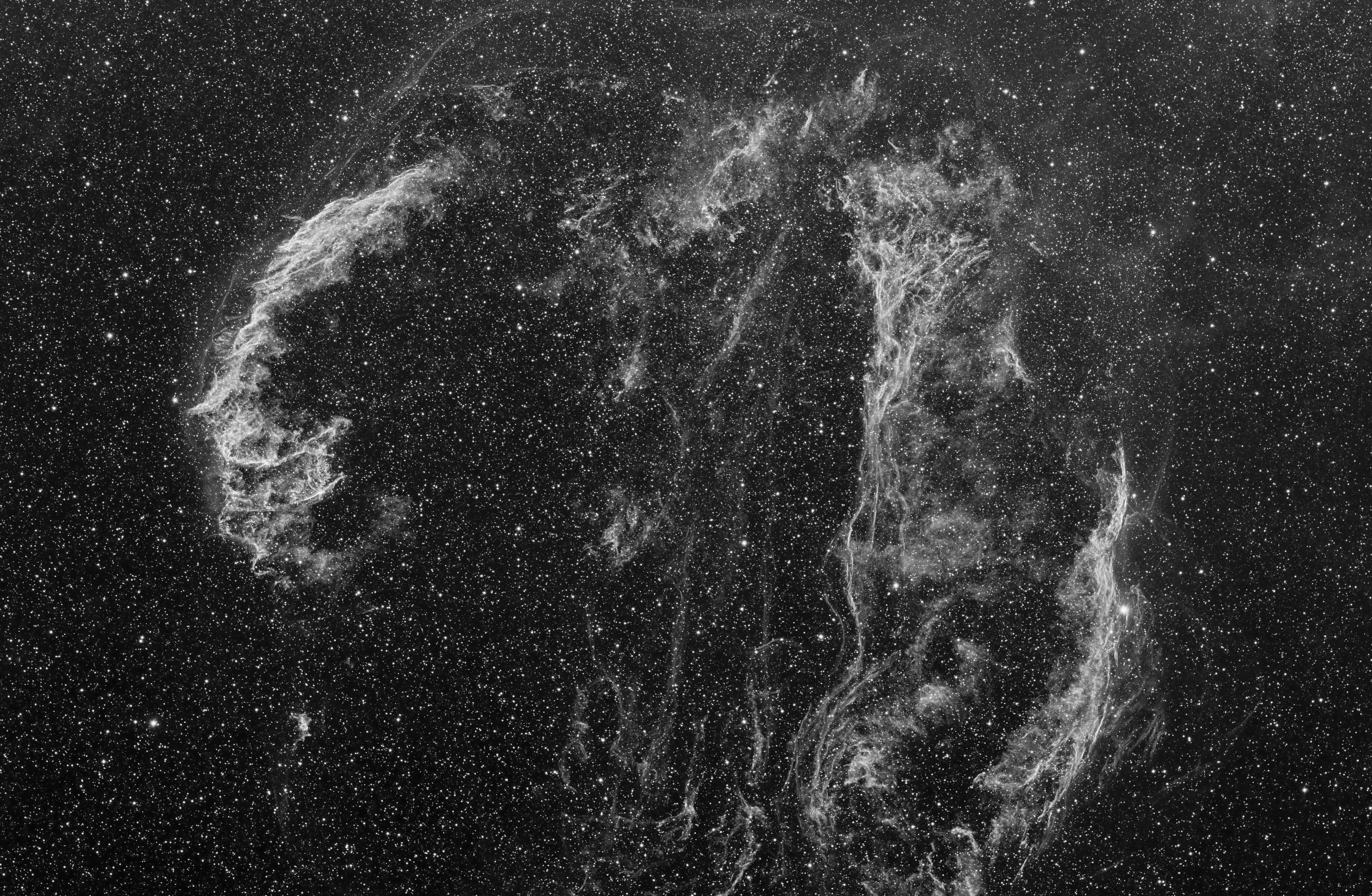
Binoculars with UHC and NPB on Veil, North American and Crescent. 15x50 stabilizers. The Veil looked very much like this photo in the binos - what a great view!


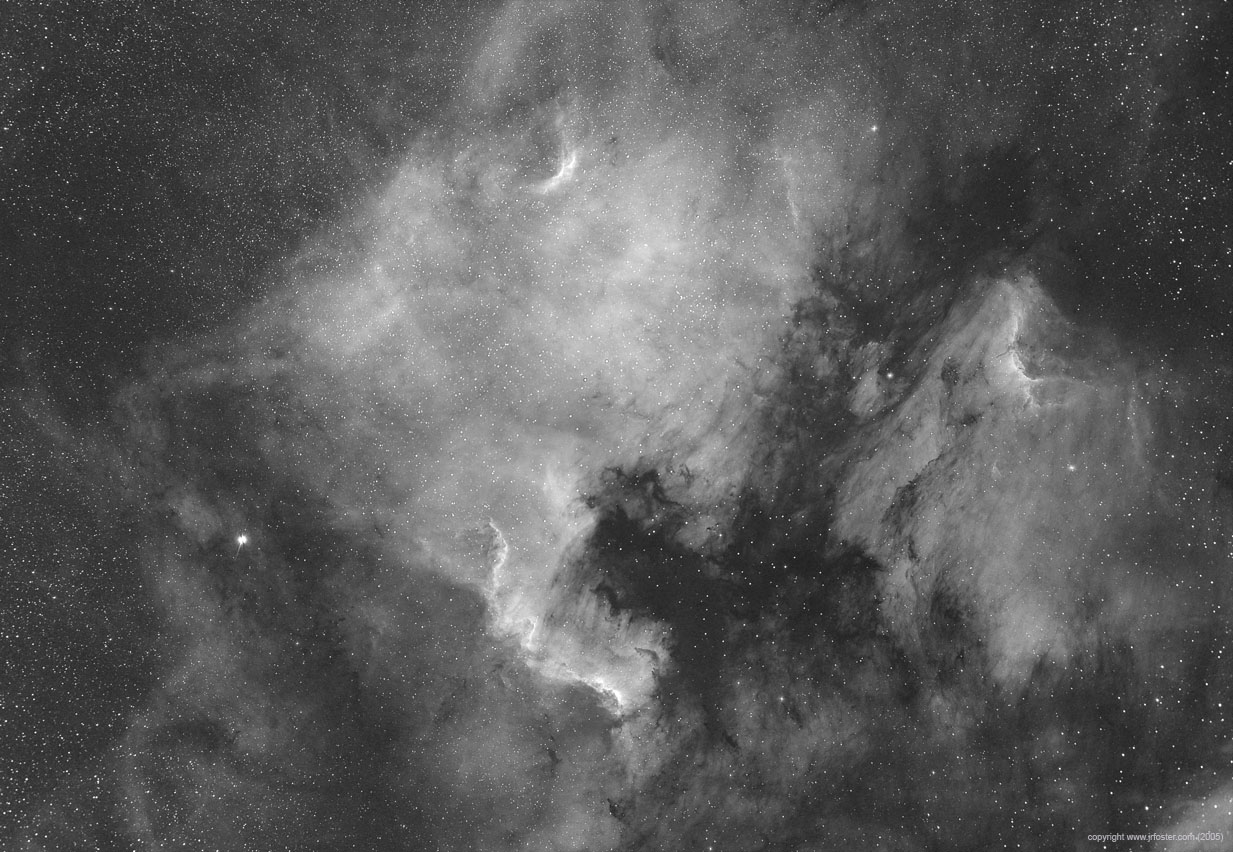
The North American stole the show in binoculars though, displaying its entire form, along with the Pelican Nebula, hands down the best view of this area I've ever seen. I swept over to the Crescent, which gave a nice view, but not comparable to that seen in a big Dob with a filter - and the entire Gamma Cygni area was filled with large clumps of glowing nebulae. Spectacular views in binoculars.


IC 469 07 55 59.1 85 09 32 V = 12.6; Size 2.2'x1.0'; Surf Br = 13.3; PA = 90d

18" 7mm- gives the impression of classic spiral galaxy tilted toward us, with mottled core area and possible sweeping arm in front, and large extended arms.


UGC 4078 = PGC 22640 08 04 24.7 84 38 29 V = 14.3; Size 2.1'x0.3'; Surf Br = 13.6; PA = 82d

18" 7mm - faint glow without central brightening. Three stars define the field, in a chain, bight and two dimmer, galaxy is off the side of center dimmer star. Galaxy seems to have hard edge or maybe dark lane on the side of the three stars. Very impressive maybe 6x1 ratio, and framed nicely in the center of three bright stars - bisecting them at a long angle.


CGCG 363-039 = PGC 23621 08 26 26.3 84 56 21 Size 1.0'x0.2'; PA = 130d

18" 7mm - this galaxy and one other small edge on proved to be the most challenging so far of the night - with only occasional "suspected" seeing a bit of it - a brightening between the two stars that flank it, and closer to the dimmer of the two.


UGC 4297 = PGC 23770 08 28 29.3 85 36 29 V = 13.6; Size 1.6'x0.4'; Surf Br = 12.9; PA = 83d

18" 7mm - bright,small, compact core with fleeting pinpoint nucleus. Core is uneven. Overall appearance is dim, but seems to have good extension, as does a dimmer elongated core.


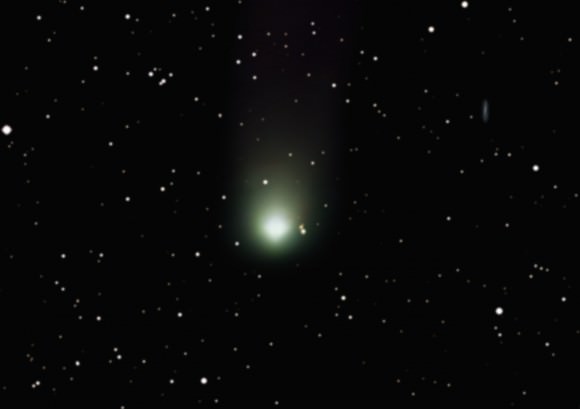
Comet in 6"refractor at low power- = bright comet, large even glow, core is tight with a very stellar nucleus.


CGCG 363-041 = PGC 23961 08 33 39.0 85 58 57 V = 14.4; Size 0.7'x0.6'; Surf Br = 12.9

18" 4mm - very dim but part of close pair. By comparison it is brighter and smaller with slightly oval shape pointing mostly away on its major axis form its partner.


UGC 4348 = PGC 24001 08 34 01.9 85 56 44 V = 14.2; Size 1.5'x1.2'; Surf Br = 14.7; PA = 21d

18" 4mm - part of pair, but larger the its companion by comparison, dimmer, separated by a definite black void.


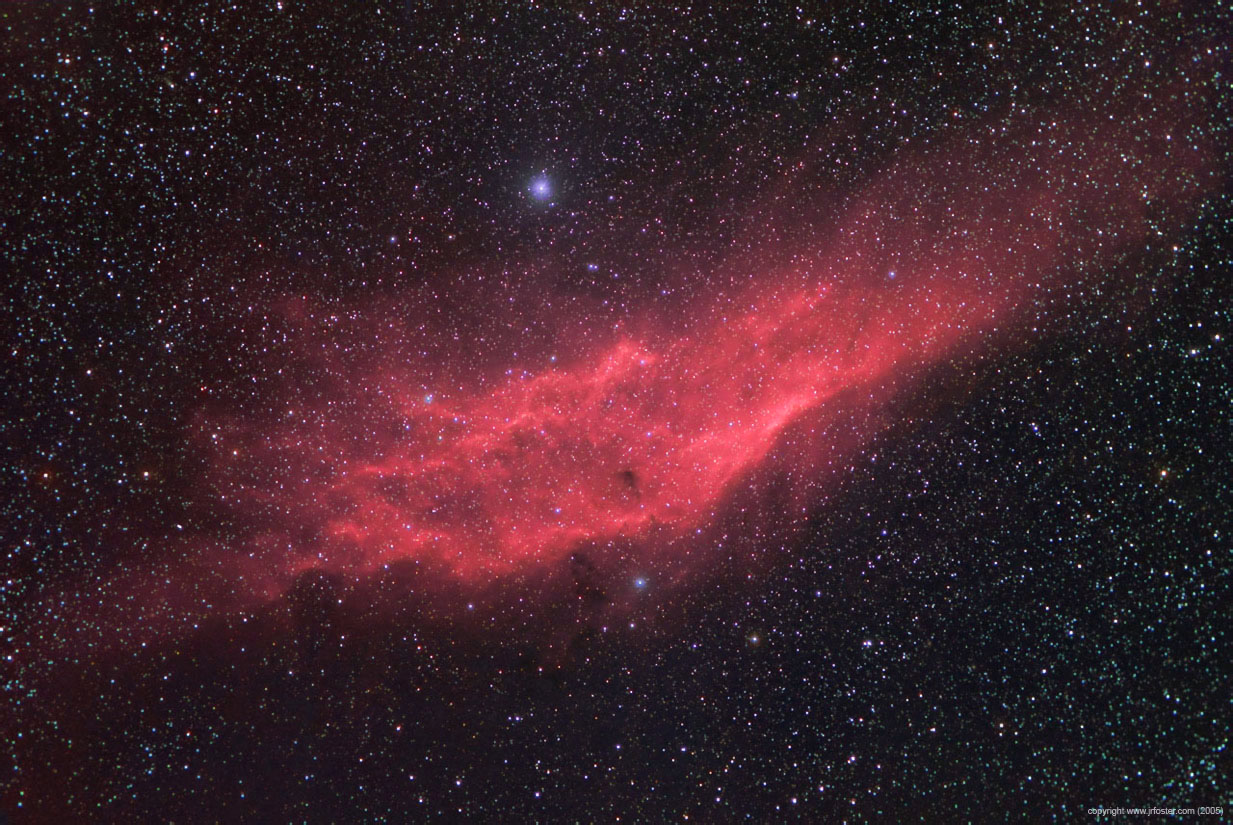
Thinking more about binocular views of the Veil and North American, I asked Steve about H-Beta filters. We came up with a pair, slapped them on, and easily found the California Nebula. The entire stretch of the object was visible, but of course it is quite tenuous, and while it did not have the "knock your eye out" impact of the others, there was no doubt we were seeing the entire target. Quite the sight.


IC 499 08 45 16.9 85 44 24 V = 12.5; Size 2.1'x1.1'; Surf Br = 13.2; PA = 80d

18" 4mm - very dim and ghostly, much like an unknown phosphorescent deep water creature who's insides show through a dim clear body. Not quite round, but not enough elongation to call it distinctly oval. Very dim star just to one side gives impression of almost an annular planetary nebula.


IC 512 = UGC 4646 = PGC 25451 09 03 49.8 85 30 06 V = 12.2; Size 1.8'x1.3'; Surf Br = 13.0; PA = 175d

18" 4mm - I've been galaxy hopping in this eyepiece, and the 7mm. This galaxy is quit4e dim., shape is indistinct. Sometimes it appears round with a sharp edge, other times it appears to extend in an amorphous shape. Amorphous extension turns out to be UGC 4612.

Sunday, August 21, 2011

A Tale Of Two Sites - Part 1

2011 continues to be a sparse year for deep sky observing. As late as the end of June, conditions refused to improve - cold, cloudy, rainy, at least over new moon weekends, when most working folks can get out to dark sites and stay up all night. However, two occasions worked out. The first was the Golden State Star Party (GSSP), in far northeastern California, near the small towns of Adin, Bieber, Nubieber and Lookout. Thanks to Jeff Gortatowski for the great photo at right - Sunset at GSSP, with Mount Shasta on the horizon. Beautiful place!

That location is in what locals refer to as the Big Valley. If you're old enough, you have visions of Barbara Stanwick and her crew. But this large open valley, 20 miles wide by 100 miles long, is a real place, with unreal skies. We are fortunate to be able to spend several nights there each year, enjoying country/small-town hospitality, with cultured and bright inhabitant. If it is possible, they outshine the stars in their night skies. If you haven't been to GSSP, look it up for next year.... it is so well organized, with so many conveniences, its like camping in your own backyard, but with the best skies you can imagine.... and all your friends there too. Winner.

The other observing trip I've been lucky enough to go on was to the Yosemite area, a wonderful long term friend named Michelle Stone, and her husband Paul Plett - own property nearby. Several old time friends gathered for 2 to 3 nights, and had some amazing conditions under which to go deep observing. And, a day in Yosemite, relaxing up at Glacier Point, made the trip even more spectacular - the ultimate combination of Heaven and Earth (the best tenchinage, for my Aikido friends!). These observations, raw notes, are combined from several nights over both trips.

I hope to return to Michelle's for a few more nights over the upcoming new moon.

Before starting though, at GSSP I was set up near Dr. Alan Argawal, and Paul Alsing. Alan has a 24" f/3.3 Starstructure, and Paul a 25" f/5 Obsession. The idea was to set up close to some big guns - I observe with an 18" f/4.5 Obsession, and be able to "mooch" some views of challenge targets. Perhaps the most challenging target discussed by my regular observing crew, is Hickson 50. One evening, early on, when The Big Dipper was still in good position, several of us went to Alan and asked to star hop off of M97, to the nearby quarry of Hickson 50. With high magnification (someone will need to remind me what we were using - maybe an 8mm Ethos), in Alan's scope, a faint haze was visible. Several of us confirmed it. Then over to Paul's 25", with the longer focal ratio, the field revealed not only the haze, but what I can describe as "sprites" - pinpoint of light that came and went, within the haze. Two of us felt there were four sprites.

There were many great views at GSSP, but for me, Hickson 50 was the most impressive. Big scopes and dark skies. Works for me!

My raw notes:

Abell 75 Cep PN 67"x47" 14.5 21 26 23 62 53 33 PK 101+8.1 = NGC 7076 = PN G101.8+08.7


Visible with 20mm no filter. 12mm with NPB filter reveals annular disk about 2.7' and round.


Abell 77 Cep PN 67"x50" 14 21 32 10 55 52 43 PK 97+3.1 = Sh 2-128 = PN G097.5+03.1 = LBN 443

Barely visible both with and without filter, both 20mm and 12mm. With VHT filter there appears to be two arcs near a small triangle to the W, one to the N and the brighter to the S.


CRL 2688 Cyg PPN 24"x6" 21 02 18 36 42 00

3.5mm ultra wide Orion without filter reveals a bright embedded star to the N and dimmer star to S within a peanut shaped halo. Very obvious and bright. Stars are actually in bright knots, with dimmer halo surrounding entire N/S combination.


Abell 78 Cyg PN 113"x88" 13.4 21 35 29 31 41 45 PK 81-14.1 = PN G081.2-14.9


12mm w/ultrablock - mostly round, dim, even brightness across disk.. Filter helps, almost not visible without.


Abell 72 Del PN 134"x121" 12.7 20 50 02 13 33 28 PK 59-18.1 = PN G059.7-18.7


12mm w/ultrablock - almost round but slight e/w elongation. Stars involved, bright one at w edge. Solid, even brightness across disk.


Hickson 89A Aqr GX4 0.9x0.6 14.4 21 20 01 -03 55 20 MCG -01-54-012


7mm all three bright components viewed averted, B seemed easier than A. C would come in with a hint of D < 25% of time.


Abell 70 Aql 45"x40" 14.7 20 31 33.2 -07 05 17 PK 38-25.1 = PN G38.1-25.4


12mm 18" - entire disk shows without filter but NE section is clearly brighter. 7mm shows annularity and galaxy visible through NE edge of nebula.


Palomar 11 10.0' 17.3 19 45 14 -08 00 26


12mm 18" - obvious granular appearance and bracketed by 2 concave chains of 4 = mag stars each running N/S with a bright star nearby to the N. Using an NPB filter shows the entire NE triangular portion of the galaxy glowing in HII.


NGC 6822 15.5'x13.5' 8.8 19 45 00 -14 48 NGC 6822 19 45.0 -14 48 15.5x13.5 8.8 Sgr


Barnard's Galaxy has a low, irregular surf br, ~14' in length. Use OIII filter to search for 2 small HII regions at N end. 12mm 18" - elongated NE/SW and embedded in stars, there is a dark rift or two that run along the major axis and several HII regions embedded, most noticeably the two at the NE end of the object.


SagDIG 3.2'x1.5' 15.0 19 30 00 -17 41 00 SagDIG 19 30.0 -17 41 3.2x1.5 15 Sgr


The Sagittarius Dwarf Irregular is a difficult 3' roundish glow nestled in a rich Milky Way field. Very difficult to identify. 7mm 18" - oval glow between parallelogram of stars, elongated NW/SE and appearing almost annular - no doubt it is there.

I've manipulated the contrast and brightness in this image, in order to try bringing out the object. Its a tough one!


Abell 66 Sgr 295"x241" 19 57 31.5 -21 36 46 PK 19-23.1 = PN G019.8-23.7

12mm 18" - Pair of stars equal mag nearby to NNE. Planetary is large and perhaps elongated slightly N/S with slight annularity. Dim stars appear embedded in E edge - perhaps 2. Very faint, although occasionally the central area appears to brighten and negate annular feeling.


Sh 2-052 2 2 19 47 46.3 -23 05 15 See next entry - how many types of catalogs is this in!

Abell 65 Sgr 134"x34" 13.8 19 46 33.8 -23 08 12 PK 17-21.1 = UGCA 415 = MCG -04-46-001 = PN G017.3-21.9 = PGC 63654


12mm 18" - visible without filter, but UHC helps. Round and mostly even brightness, but SW edge seems brighter than rest of disk. Chain of 4 dim stars cup N edge, and 3 dim stars extend W from S edge, with E star touching disk.


ESO 461-007 1.2'.7' 13.3 19 52 06 -30 49 00
7mm 18" observed, aka Hickson 86A
Hickson 86A 1.2x0.7 13.3 19 52 08.7 -30 49 30 63753
Hickson 86B 0.5x0.4 13.8 19 51 59.0 -30 48 57 63748
Hickson 86C 0.4x0.3 14.9 19 51 57.3 -30 51 23 63752
7mm 18" observed.


Terzan 8 3.5' 12.4 19 41 45 -34 00 01

12mm 18" - forms an almost equilateral triangle with GSC 7434:401 and GSC 7434:31, but feeling is I'm seeing the core as it is relatively small and not all that difficult.


ARP 29 11.6'x9.9' 8.8 20 34 52 60 09 NGC 6946


Large core with two arms coming off to NE and swinging E. S of the 2 arms is fatter. Dimmer arm comes off S of core and swings tightly around to W. Large core has a gradually brighter center. Finally noticed another long arm, from WNW and winding around straight to NE.


Abell 71 Cyg 165"x150" 14.5 20 32 23.2 47 21 04 PK 85+4.1 = PN G084.9+04.4 = Sh 2-116


7mm 18" - very dim glow, no definition at all, surrounding a mag 13.5 star with more "glow around a mag 12.5 star on the edge. Extremely difficult. Dim star actually appears involved in a haze.


Sh 2-115 50 2 20 34 33.0 46 52 40


12mm UHC 18" - dim linear glow with some structure running E/W of two pair of stars to the S. Dimmer pair appears involved in nebulosity. OC Berk 90 is obvious at E of the two pair of stars.


Sh 2-112 15 2 20 33 50.2 45 39 35


12mm UHC 18" - easy to view this Sharpless around GSC49801. Nebulosity forms an arc through the star, running mostly N/S and arcing to the E, forming a J with most but thinnest section to the N. Bottom of J is most pronounced.[


AGC 2319 0.973 15.4 19 20.8 43 59


7mm 18"- CGCGs 230-9, 230-8, 230-7, 230-4


Sh 2-108 180 3 20 22 34.8 40 15 15 IC 1318


30mm 18" - nebulosity with dark neb veined throughout over large areas around Gamma Cygni, through into the North American Nebula. Outstanding views throughout the entire area.


Abell 69 Cyg 25"x22" 20.2 20 19 58.3 38 24 02 PK 76+1.1 = PN G076.3+01.1


7mm 18" - perhaps at most the southern arc of this planetary, very elusive.


Sh 2-105 18 3 20 12 02.4 38 20 59 N6888 = Crescent Nebula


12mm 18" UHC - spectacular view, wispy nebula with blue glow and blue stars. Internal knots inside western edge, northern and eastern edge very thick and distinct. Mottling throughout. Star embedded in northeastern wisp is very reminiscent of Veil Nebula's Witches Broom.


Sh 2-106 3 3 20 27 26.9 37 23 49


12mm 18' UHC - amorphous glow involved with dark veins interspersed in distinct star field just NNW of SAO 70038. Subtle, but there.


Sh 2-104 7 2 20 17 44.6 36 44 40


12mm 18" UHC - faint but distinct even nebulosity surrounding stars of Dolidze 4, elongated E/W, with a notch taken out of the NW edge.