Monday, August 5, 2013

Bright Night Targets at Houge Park

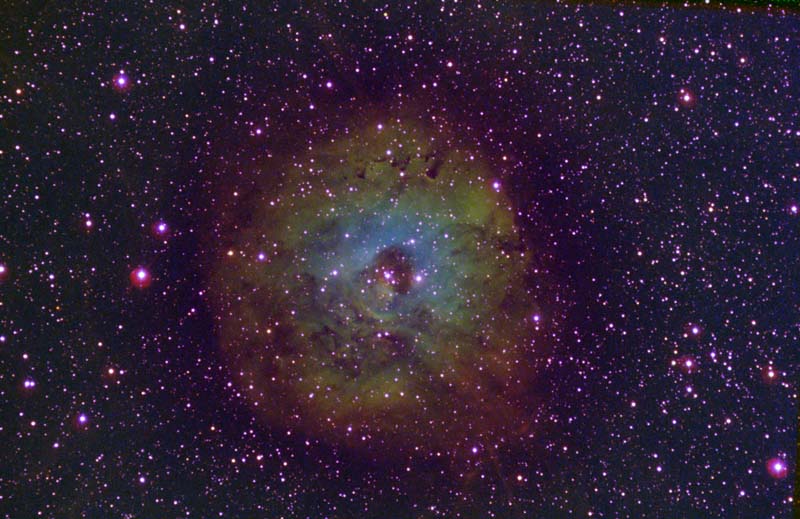
Last night I taught a beginner astronomy class for the SJAA at Houge Park. After the class, I went outside and joined the public star party, using my 10" f/5.7 Dob. The idea was to show some of the constellations I'd described in the class, and show a few of the objects within them. Hercules, Ophiuchus, Serpens Cauda and Sagittarius.Green laser to outline the constellations. The green laser worked wonderfullyfor that - the sky, with some significant moisture content (things were getting pretty dewy) was brighter than the really good nights at Houge - it was nearly impossible to see the Milky Way other than as an imagined brightening higher up, through Cygnus mostly. But the bright stars that make up our recognized constellation figures showed decently enough.

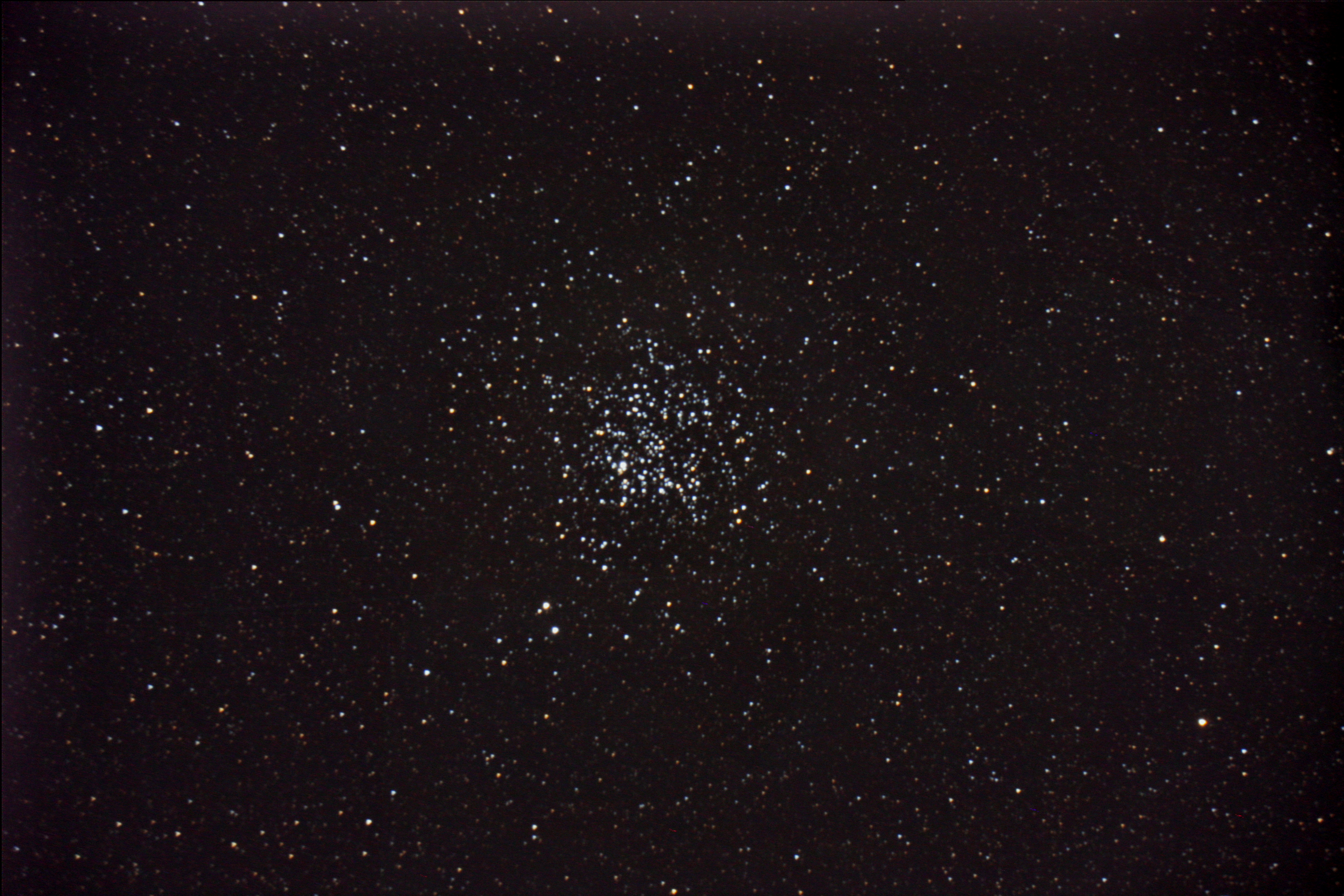
M11 - The Wild Duck Cluster

I had forgottenthat I also had listed a few items in the club's newsletter - and some of the attendees were coming up and asking to see them in the telescope.NGC 7662 - The Blue Snowball - forget it. Way to bright down low in Andromeda. M11 - The Wild Duck, in Scutum... well... where the heck was Scutum in that muck? I had to pull out a chart to guess at the approximate location - but fortunately I landed right on the target. Interesting, finding people saying they saw the object, after it had drifted out of the field! I made sure to call them back, and have a good look. It is really a nice sight, and showed decently in the less than ideal conditions.

I had described and shown photos and drawings during class of M8 and M22 in Sagittarius. M8 showed well with a UHC filter - the glow and bright knotted sections of nebulosity were obvious, and the associated open cluster adding to the aesthetic. M22 looked washed out. Kind of disappointing, but it was there, and that was about as good as it got.

Eta Cassiopeia
Globular Cluster M15
I took people on a tour of three double stars - which are easy on less-than-ideal nights. The obvious Albireo - bright and colorful. Then over to theEpsilon Lyrae, the Double Double - splitting nicely at high power. Everyone enjoyed that - and asked the usual question - "How many miles between them?" I dunno. A few arc-seconds? :-) Then I jumped over to Eta Cassiopeia, in order to show the copper penny. I love Eta Cass, what a great color.

There were long lines of people, and a good turnout of volunteers with telescopes. I am sure they were showing Saturn - even with it dropping down into the muck now. I finished up with a comparison of some globular clusters - M13, M92, and M15. Because of its highly condensed core of stars, M15 really showed the best. M13 and M92 required some "work" to see - and you certainly could resolve them, but I think it was too much for first timers to really "get it" when trying to see those dimly in the conditions. M15 on the other hand had that tight bright knot of deep core stars, and seemed to work well.

The one thing I would loved to have shown, but the conditions didn't allow, was the steam coming from the spout of the Teapot. I had describe that in class as well, but the real thing will have to wait for another night. So it goes, in amateur astronomy!

Sure had a fun time. Lots of interested beginners, and families with their kids.

Nights are getting longer, and weather is going to change. Get out and enjoy the sky, while you can.



Sunday, September 16, 2012

A Close Site And Short Nite (Only A Northern Sky)


When one is handed a lemon.....

Well, I had planned on a full three nights at CalStar this year, but circumstances dictated otherwise.  In retrospect, probably a good thing.  I'm not up to 110 degree heat, as a survivor of the infamous Shingletown Star Party bake-a-thon (is that place still there after the fires?) many of us recall.  So, on Saturday I looked at the options of closer (but brighter) observing sites, and eventually settled on joining the Santa Cruz Astronomy Club at Bonny Doon Airport in 40 minutes from my home south of Aptos.  It had been a nice day on the coast, with dinner on the Municipal Wharf,  followed by the quick drive past ocean and redwoods to the observing site.

Arriving at sunset, I found a few other observers present.  John Pierce, Ron Yelton, Bill Seiler, a newbie woman named Terri, and off in the dark distance... Dean.  I quickly removed my 18" Obsession from the back of the Fit, set it up on my Equatorial Platform, collimated, aligned finders, got my laptop and battery set up on a collapsible table... pork rinds and water in place, and before you could say "hey... there's the Milky Way", I was observing.
Bonny Doon is great for its convenience to those of us on the coast.  I had considered Coe, but it was twice the drive, and I thought the skies only marginally better.  I'd really be interested in determining a mag-limit difference between the places on average nights.  I do know that when the fog is in, over Santa Cruz, BD can be dark.  But last night there was significant glow to the south over Santa Cruz, and to the northeast over San Jose.  The Milky Way never showed the sugary granularity we so enjoy on the best nights.  But... 40 minute drive, wide open sky.... I'm not complaining.  In fact, thanks to the SCAC for making this available!

So, all that said, I will report that I observed until about 12:15 a.m., and concentrated on part of the 140+ targets I had identified for the three nights of CalStar (no, I didn't expect to observe them all).  I worked only a northern sky - curious what I could see from this location.  I was pleasantly surprised!

I had commented to Dean, who is traversing the Herschel 400-II, that my days (and I suspect his) of logging 50 objects a night, are done.  These tend to be tough, but doable, requiring exercising the eye and patience, and swapping eyepieces and filters.  My telescope is an 18" f/4.5 Obsession, I track using an Equatorial Platform.  Finders are a Rigel Quickfinder and ancient Celestron 10x70.  All filter views were using an NPB.  Eyepieces were all Nagler type II - 20mm/103x, 12mm/171x and 7mm/294x.  Total observing time was on the order of 3-1/2 hours.

When I was driving home afterward, the fog was coming in... and at 10 a.m. here, as I write this, it is still in.  Fog means, dark skies.

For those interested in Bonny Doon


Next month, on new moon, I plan on joining the SJAA at Coe, and help out at that club's Half Messier Marathon.  Sounds like fun. 


Here are the dozen targets I tracked down last night...
 

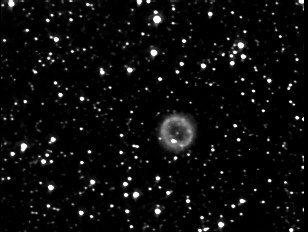
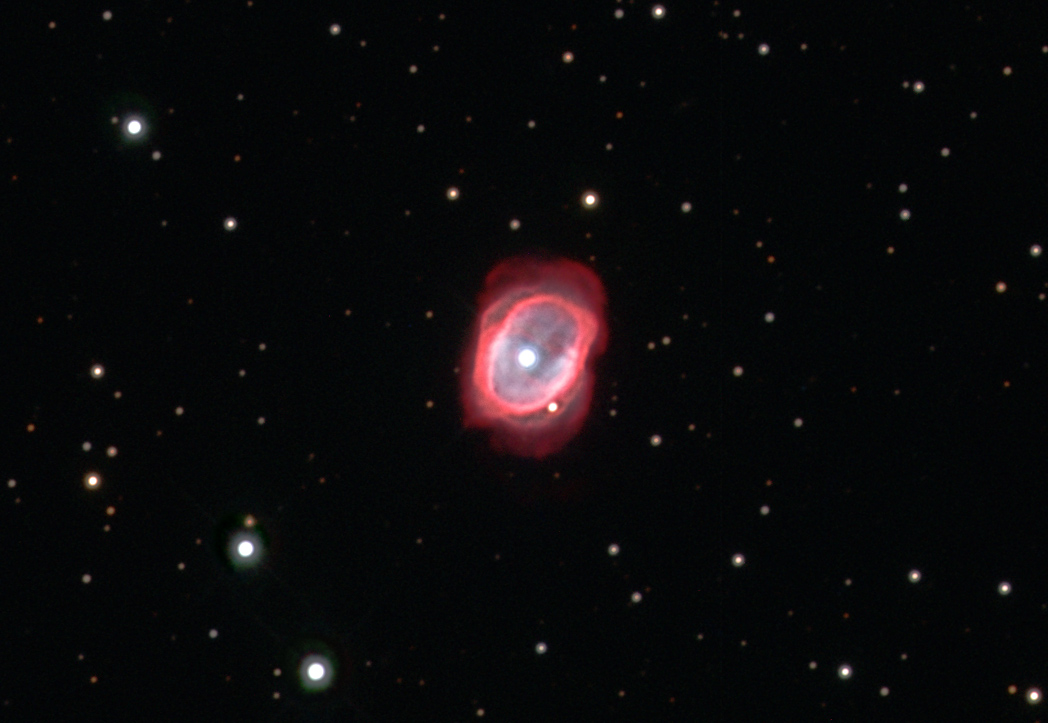
Abell 81 PK 117+18.1 = IC 1454 = PN G117.5+18.9    22 42 25.0    80 26 32    34"x31"    14.4    Cep
7mm NPB - Easily visible, annular with averted vision, thick ring elongated E/W.  Noticeable without a filter.


Abell 86 PK 118+8.2 = PN G118.7+08.2    00 01 31.2    70 42 29    70"        Cep
12mm NPB - Suspected large annular, or perhaps just a large part of the edge but not complete - mostly the thick western 2/3rds.  With time, haze shows.


NGC 7023    21h 01'    68° 00'    8        Cep
12mm NPB - Nebulosity most noticeable surrounding mag 7.3 SAO19158.  Surrounding area shows much dim nebulosity, and bright knot surrounding 3 dim stars about 34 arcminutes west of bright star.


 NGC 7129    21h 41'    65° 50    2    9.3    Cep      
7mm -NPB - Ended up looking at very nearby NGC 7133 - much more interesting. Containes three IC objects, and four distinct glows.  Three brightest are surrounding stars, fourth glow has a very dim star involved and is identified as LBN 497.  Very pleasing view.


S 170    23h 59'    64° 23    20        Cas      
12mm NPB - Nebulosity is involved dimly throughout region mostly involving three stars of nearly equal magnitude, and a fourth dimmer star much removed to the south, out of line in what otherwise would form a parallelogram.  The north eastern star is most involved, with the brightest and most extensive glow.


 Abell 6     PK 136+4.1 = PN G136.1+04.9    02 58 41.9    64 30     188"x174"    15    Cas
12mm NPB - Fairly large undifferentiated glow, very dim stars involved, and occasional knottiness.


Abell 3 PK 131+2.1 = Sh 2-189 = PN G131.5+02.6    02 12 06.6    64 09     60"    16    Cas
20mm NPB - Only suspected a glow.  12mm NPB glow appears to involve several dim stars, but no detail.  7mm NPB reveals the suspected glow as three dim stars, but these are involved in a half arc of nebulosity extending from those three stars to the west, then around to a one dim star to the south.  Appears planetary may be annular with a missing eastern edge.


Abell 75 PK 101+8.1 = NGC 7076 = PN G101.8+08.7    21 26 23.6    62 53     67"x47"    14.5    Cep
20mm NPB - Easily visible with averted vision as a mostly round glow.  With 7mm NPB, appears mostly round but eastern half is much brighter and more well defined.  Somewhat annular and with a thin but complete western "strand" that completes the disk.


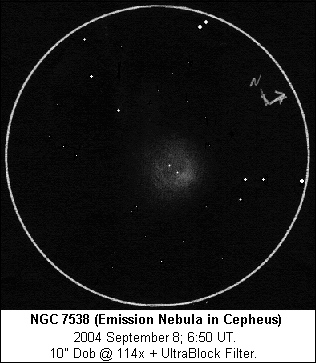
NGC 7538    23h 12'    61° 13    7        Cep    Sh2-158  
7mm NPB - Nice glow around a pair of brighter stars, at first appears to just be localized to the stars, but with averted vision more and brighter nebulosity appears throught the region immediately to the NNE.  Suspected much larger plume to the E of the bright area and curving around to the S, as if mirroring the N but much more dimly.


NGC 7635    23h 18'    60° 55    8        Cas    sh2-162  
20mm NPB - Easily visible especially around SAO20575.  Extends noticably NE/SE across the bright star, and away to the SE in a large dim glow.  7mm defines area SE of brighter area as the Bubble, a fairly even mostly round glow somewhat elongated NE/SW, with several dim stars involved.  Mostly even brightness across Bubble, but with a less well defined ESE edge.


NGC 7380    22h 45'    57° 45    20    7.2    Cep      
20mm NPB - Nice open cluster with nebulosity.  Glow encompasses entire cluster, with nicely defined eastern edge, a line of stars running N/S.  A lesser chain defines the N edge of the nebulosity, which appears mostly triangular in its brightest section.  A dimmer section, also large, appears to be brokien off to the south, as if separated by a dark lane.  Nice object.


Abell 2 PK 122-4.1 = PN G122.1-04.9    00 45 36    57 57.    33"x29"    14.5    Cas
12MM NPB - Easy location and easy to see.  This small round glow is 7 arc minutes south of mag 8.3 SAO21680.  With 7mm and NPB, it appears at times annular and elongated slightly NE/SW.  This is a farily obvious Abell planetary.

Sunday, August 19, 2012

A Grand View of the Ancients

I'd been talking about a trip like this for maybe a dozen years.  Always put off by the distance.  Then a group of friends, led by Steve Gottlieb and Paul Alsing, decided to do it.  Paul has been numerous times, Steve, not since the 90's.  The destination, Grandview Campground at 8600 feet on the western flank of White Mountain.  Driving time estimated at 8 hours, but with stops and Yosemite traffic, closer to 9,

The weather forecasts were not very promising, and I was very reluctant.  But I had convinced my buddy Richard Navarrete that this was the best opportunity I could think of, to do it, and even with my thinking of backing out, he was in.  How could I not go?

So, at 10 a.m. on Wednesday August 15th, I found myself on the road, 18" scope, observing and camping gear, all packed into a little Honda Fit.  The drive was long, up till I got into the eastern reaches of Yosemite, heading for Tioga Pass.  Then the drive became pleasurable - with unmatched scenery - all the way to the campsite on White Mountain.

White Mountain is a great place to observe.  The fact that it had been a finalist for locating the Keck Telescope, and you know there is dark, and steady seeing.  And in addition, there lived up top, the oldest living things in North America - the Bristlecone Pine.  I had always wanted to see them.

So, soon I was unpacked, and camp set up.

At the end of this narrative, I'll list a few of the targets I observed through the telescope.  Ancient light.  But the weather indeed turned out to be pretty poor for observing, so that time was limited.  But, the trip was great anyway - the views of the ancients in the Patriarch Grove, and the scenery at 11,000 feet on the dirt road leading to it, was easily worth the 18 hours driving over three days and two sleepless nights.

Here are a few photos...

Upon arrival, I found this was indeed a very astronomy friendly campground!
 
  There was no problem with room for our campsites or astronomy gear.

We certainly had some memorable views. heading up to the Bristlecones

 This view is east into the Great Basin

This view is west, toward the eastern slopes of the Sierra Nevada

It is a moonscape at 11,000 feet.

  
But the trees, anywhere from 15 to 45 feet tall, and incredibly beautiful....
 
 Made every minute of the drive...

 ...worthwhile.  Never have I seen anything like it!

 Even the drive back home, along highway 395, was spectacular!

But we came for astronomy.  Here, to augment the views of the ancient trees, are reports of some ancient light I took in as well... all observations (raw notes) are using an 18" f/4.5 Dobsonian, all eyepieces are Naglers.  I had a great time, as limited as it was for observing.


Abell 68    Vul    PN    40"x37"    15.2    20 00 10    +21 42 58    PK 60-4.1 = PN G060.0-04.3  
7mm uhc-very slight glow, maybe only one edge away from dim chain of 4 stars, toward brighter one.  Very faint and intermittent.  With NPB, shows better and closer to brighter star, possibly annular with brighter edge toward bright star.


N 6852    Aql    Paul's Picks    28.0"    12.8P    20 00 39    +01 43 41    
Easy to locate, visible as hazy small smudge in 20mm.  7mm no filter reveals dim but certain disk, with hints of annularity.  With NBP filter annularity is striking.  Nebula is nearly round and situated between two very closeby stars.  Dimmer of two stars mauy be involved in very dim elongated extension of nebula.


Sh 2-099    Cyg    BN    5    3    20 00 50    +33 29 34        Problem locating on Megastar, shows Sh2-81.  Check it out!

N 6857    Cyg    EN    1.0x1.0        20 01 47    +33 31 38        With NPB and 7mm, planetary is very bright and obvious..Sh2-100 shows nicely without a filter and at lower power (20mm and 12mm).


NGC 6866    Cyg    OC    6    9    20 03 54    +44 00 00        20mm - scattered, broken cluster of several dozen stars, seemingly stretched in an elongated shape, but with a condensation in the middle.  Many nearly the same magnitude.  Takes up about 23 arc minutes by 5.


NGC 6882    Vul    OC        5.5    20 11 54    +26 33 00        20mm - combination of two clusters, 6822 and 6885.  Very large rich groups, with great magnitude reanges, and strewn over large area.  Overflows 20 Nagler field.

NGC 6885    Vul    OC    20    9.1    20 11 54    +26 29 00        20mm - combination of two clusters, 6822 and 6885.  Very large rich groups, with great magnitude ranges, and strewn over large area.  Overflows 20 Nagler field.

 N 6894    Cyg    PN    44"    12.5    20 16 23    +30 33 55        7mm and NPB, bright, ragged appearance, mostly round, brighter along inner edge of ring, and in two opposite sides.


Sh 2-104        BN    7    2    20 17 44    +36 44 40        20mm and NPB shows nice tight group of stars in Dolidze 5 along with lots of nebulosity surrounding the group, and spread throughout the area around brighter stars.  Worth a visit! IC4996?

Sunday, April 22, 2012

The Whirlpool's Coils


 A short report from DARC Observatory last night.  DARC is a private property, southeast of the San Francisco bay area, located near Mercy Hot Springs in Little Panoche Valley.  It is dark, remote and desolate.
  
Below are objects I observed (and tried to observe) with my 18" f/4.5 Dobsonian.  All eyepieces are type II Naglers.  Conditions at DARC could not have been better.  Temperatures must have been in the high 80's at 7pm when I arrived.  During the night, there was no more than the slightest breeze - enough to just help cool us down, as we could have been in t-shirts all night long.


 I began by observing NGC 2903, and Ariana Bernal Adreo came over asking to see something in my telescope.  She suggested Venus, but being the Klieg Light that it is, I suggested something less jarring.  So, we went on a little tour.  I began with Saturn, which was nice, but a bit soft.  Then I progressed out to M3, explaining to Ariana that it was still part of our galaxy.  She liked the globular.    Wondering what to show her next, I asked my observing buddy Richard Navarrete for suggestions.  The Whirlpool!  Well placed, it showed great detail.  Ariana easily understood that she was seeing spiral arms.  I suppose some knowledge has rubbed off from her dad.  So, after two galaxies, what else?  Richard?  Ah - the Leo Triplet!  In my 20 Nagler, they sat around the edge of the field.  But Ariana was able to pick them out.  Three galaxies are certainly better than two!  Ten years old, and observing through a big scope - this sounds so familiar to me!  From there, I moved to M84 and M86, the heart of the Virgo Cluster - and asked Ariana to count the galaxies in view - well - four.  Four galaxies in a single view!  Astronishing!  So, I told Ariana about Markarian's Chain, and suggested she tell her dad what she'd seen.  Later, Rogelio came by, and told me these were the first objects his daughter has seen in telescope, that are outside our galaxy.
 
 I was soon back on my program.  In order to just take it easy, I had copied the Spring Favorites from the Adventures In Deep Space web-page:  http://www.astronomy-mall.com/Adventures.In.Deep.Space/spring.htm
 
I took my time, relaxed, and thoroughly enjoyed myself.  I think the most interesting "find" for me was the Eight Burst Nebula - it is so far south, I knew none of the star patterns, and there was enough extinction down low that I found myself guessing at where it might be.  After a lot of looking, and scratching my head, I pointed the scope at the horizon, and .... surprise!.... there it was.  I had to hold the front of the scope down in order to see it.  Also very rewarding were the two galaxy clusters, NGC 3158 and 3166.  I hit my mag limit for the night on MCG+7-21-7, which was at the extreme limit of visibility.
 
In the morning, I woke, and while packing up, lifted my equatorial platform, and found, nicely coiled like The Whirlpool Galaxy, a baby rattlesnake - who was sleeping in the shade of my gear, on this already hot April morning.  I didn't need a cup of coffee, after that....

Thanks to Rogelio Bernal Andreo and Lee Hoglan for hosting our group.  It was an excellent outing, start to finish - a wonderful two hour drive from the Santa Cruz area, out of the domain of man, and I was seeing things, in the dark,  through a telescope (made of glass and wood) - half a billion light years away,   What perspective.


NGC     NAME     TYPE     CON     RA     DEC     VMAG     URA2      

NGC 2903  na     G    LEO     932  2130  8.9 

12mm - bright and elongated 3x2 with strong central condensation across most of the major axis.  Very strong small elongated core that appears round with ansae.  Condensation in arms shows well (NGC 2905).      


Hickson 40  GAL GR  HYA  939    -451 12.8   
 

7mm - 4 members are obvious, 5th does not show up.  Three brightest all have pinpoint bright stellar nuclei, dimmest member does not.  All members are elongated and at divergent angles to each other.     


Double Quasar    QSO     UMA     1001     5541     16.5   
Negative observation.


NGC 3115 Spindle  G  SEX   1005  -743  8.9 

12mm - very bright extremely compact core.  Arms are very thin and very long.  Stellar nucleus is noticeable inside small but elongated core.  Arms ratio fo at least 10x1, and bright.  Highlight object.     


NGC 3132 8-Burst  PN VEL 1007  -4026 9.2 

7mm - large and bright nebula with bright cental star.  Slightly elongated, with a large number of "stars embedded.     


NGC 3158  GAL GR LMI 013  3846  11.8
 
7mm - 11 galaxies in close proximity in view - most challenging MCG+7-21-25 and MCG +7-21-27 both on edge of perception.  NGC 3163, 3161, 3159 form a nice compact chain with MCG+7-21-19 at the W end.  Off further west were NGCs 3151 and 3150.  N was NGC 3158 - the most obvious and largest in the group, with NGCs 3160 and 3152 to its north.  Very nice compact group of galaxies.     


NGC 3166   G  SEX  1014  326   10.4

7mm - NGC 3169 appears disrupted with a bright core that is elongated mostly e/w, and a quickly and randomly diffusing halo.  NGC 3166 lies 15' to its w and has a compact non-stellar core elongated slightly e/w, with a diffuse halo slightly elongated in the same direction.  8' to the west of 3166 and past two dim stars is a non-descript faint glow barely visible, without distinct elongation or direction.  Continuing approximately 30' SW is NGC 3156, a moderately bright galaxy with indistinct shape, a brighter compact large core and a feeling of a disrupted portion extending south.


Hickson 44 GAL GR LEO 1018     2150     11

20mm - beautiful grouping of four obvious galaxies - three in a line, forth close by to the nw of the middle member of the linear group.

Sunday, August 28, 2011

Pole Dancers

Now that I have your attention....

A few days ago, I mentioned on a public observing forum that I was wondering what to observe next. My observing partner, Steve Gottlieb, immediately chirped "how about 25 galaxies within 10 degrees of Polaris". I remembered him mentioning such a project a month back, and learned that in fact he had observed this list very recently at Sierra Buttes, at 7200 feet elevation in the Sierra Nevada. So, I took up the challenge, and last night at Willow Springs I attempted the list. While Willow is only 2200 feet elevation, lacking the transparency benefits the Buttes has, it is a still a very good "local" sight, a mere 2 hours from my home in the south San Francisco bay area.

A few words about the vagaries of this particular weekend - several of us were going to head to a friend's property near Yosemite to observe. The morning we were to leave, the weather forecast showed poor condition - potential thunderstorms, bad seeing and transparency.... we were unsure... weather reports are not always reliable. Then, as I was packing, I got a text message asking what I knew about the fire near Yosemite. Turned out, our destination was under evacuation warning, and choking in smoke. The ONLY fire in the entire state of California! Change of plans. We headed to Willow. Arriving there, the sky was filled with....


smoke.

From a new nearby fire!

Well, it was put out, and the sky cleared nicely. We enjoyed a fine evening observing, but it just goes to show, sometimes you just dodge a bullet ... and get lucky.

So, the Pole Dancers. 21 galaxies Steve sent me in list form. Actually, in an article, but I'll leave the specifics of that to him to discuss. The galaxies were all within 5 degrees of Polaris, and varied from dancers you couldn't take your eyes off of, to those you barely knew were there, or cared. Of the 21, I had 19 confirmed, the remaining two were "suspected" at best - UGC 3661 and CGCG 363-039.

I have to also note, I observe with an 18" f/4.5 Obsession, made in 1994. The mirror has its original coatings, and the only thing I've added is an Equatorial Platform, made by the master, Tom Osypowski. I love tracking, it makes the experience much more relaxed, and I feel I see much more not having to constantly worry about moving the scope at high power (note some of the eyepieces I use in this report). But, observing these targets, so close to the pole, I was able to turn off the drive, and just let the happy circumstance of being very close to the pole do the job of keeping my targets in the field of view. And.... I also never used my ladder, or moved my obseving chair. I could get used to watching pole dancing! ;-)

Finally, another great parts of a trip like this - with experienced and accomplished observers (included Mark Johnston and Richard Navarrete) - - - is sharing views. I've listed a few here in my report.

Thanks to Kevin Ritschel for hosting us at his property, great to see him again.... and thanks to Steve, for the project!

Here are my notes on the 21 Pole Dancers.

NGC 2268" 07 14 17.6 84 22 57 V = 11.5; Size 3.2'x2.0'; Surf Br = 13.4; PA = 63d

18" 7mm Obvious large elongated core in a slightly elongated e/w disk. Pinpoint nucleus comes can be held.. About 2'x1', fairly even gradual dimming from core to edges.


UGC 3528A = Arp 96 07 02 27.4 86 34 46 Size 0.8'x0.6'; PA = 63d

18" 7mm very dime pair with not much detail. Very close together, both have clear pinpoint nuclei, one closer to bright star has brighter obvious stellar nucleus. Both have indistinct hazy roundish disks. With 2x Barlow and 7mm, further out galaxy disk is bigger, brighter, and elongated N/S. Other galaxy disk is smaller, dimmer, and roundish.


UGC 3536A = Arp 96 07 03 22.0 86 33 28 V = 13.6; Size 0.7'x.0.6'; Surf Br = 12.7

18" 7mm very dime pair with not much detail. Very close together, both have clear pinpoint nuclei, one closer to bright star has brighter obvious stellar nucleus. Both have indistinct hazy roundish disks. With 2x Barlow and 7mm, further out galaxy disk is bigger, brighter, and elongated N/S. Other galaxy disk is smaller, dimmer, and roundish.


CGCG 362-033 = PGC 20191 07 08 15.1 86 39 29 Size 0.8'x0.3'; PA = 109d

18" 7mm w/2x Barlow - elongated SE/NW and 3x1 ratio. Inner 1x1 section is fairly even brightness, then falls off at extensions.


UGC 3654 = PGC 20601 07 17 47.1 85 42 48 V = 14.3; Size 0.4'x0.3'; Surf Br = 11.8; PA = 17d

18" 7mm w/2x Barlow - very small and nearly round, but slightly elongated. Dim stellar nucleus, elongation is N/S.


UGC 3661 = PGC 20655 07 19 45.0 85 46 01 Size 1.1'x0.25'; PA = 12d

18" 7mm w/2x Barlow - very fleeting view of just a small section of this thin galaxy.


UGC 3670 = PGC 20677 07 20 04.7 85 35 14 Size 1.0'x0.5'; PA = 40d

18" 4mm - very dim, elongated, even brightness, E/W elongation of about 3x1.


NGC 2276 = Arp 25 07 27 14.4 85 45 16 V = 11.4; Size 2.8'x2.7'; Surf Br = 13.5; PA = 20d

18" 7mm - fairly bright and obvious, compared to others this session. Round, fairly even brightness, mostly featureless except for small slightly brighter round core and dimmest of averted vision pinpoint nucleus.


NGC 2300 = Arp 114 07 32 20.0 85 42 32 V = 11.0; Size 2.8'x2.0'; Surf Br = 12.8; PA = 80d

18" 4mm - very bright very tight inner core with no discernible nucleus, and chaotic appearance. Quickly gives way to significantly dimmer outer core that extends at least three diameters of the inner core in diameter. Outer core extends over 1/2 way to brightest close star to the W. Possible HII to the SW. More possible HII toward pair of stars pointing away to the NNE.


sh2-71 nice detail! Viewed this in Steve Gottlieb's 18" Dob. With an OIII filter, much of the detail shown in this image was visible. The central star was very evident. Without the filter, the object took on a distinctly circular shape, was much less obvious - looked like an Abell Planetary, with an obvious central star. A very interesting object!


MCG 04-029 = PGC 21210 07 32 25.9 86 40 00 V = 14.3; Size 1.2'x0.6'; Surf Br = 13.8; PA = 45d

18" picked up with 12mm, off the end of a chain of four brighter stars framed at the target end by three collinear dimmer stars. Easy fin. Galaxy is small and elongated. The fact that the two collinear chains point into the field, make this a visually pleasing view with the galaxy as a highlight. Chains of stars are E/W, galaxy is mostly N/S, and seems to have brighter central section, and a bright knot to the S. Elongation is N/S.


IC 455 07 34 57.7 85 32 14 V = 13.3; Size 1.1'x0.7'; Surf Br = 12.9; PA = 82d

18" 7mm - picked up easily in 20mm, galaxy has a bright core and inner disk with apparent spiral arms extending


CGCG 362-045 = PGC 21817 07 48 01.0 85 33 07 Size 0.8'x0.6'; PA = 64d

18" 4mm - nice tight small core that appear chaotic. Occasionally a tiny bright pinpoint stellar nucleus appears. From core two close arms appear to extend only slightly, then a a larger disk that shows easily only on the side to S.


UGC 3993 = PGC 22202 07 55 44.0 84 55 35 V = 12.8; Size 1.6'x1.2'; Surf Br = 13.4; PA = 35d

18" 7mm- showed up at that magnification close to a tight uneven double star. Appears chaotic in its bright core..Entire core area is larger than first appeared, and even more disrupted - a dark intrusion? Surrounding is a large dim disk, more noticeable on the double star side.


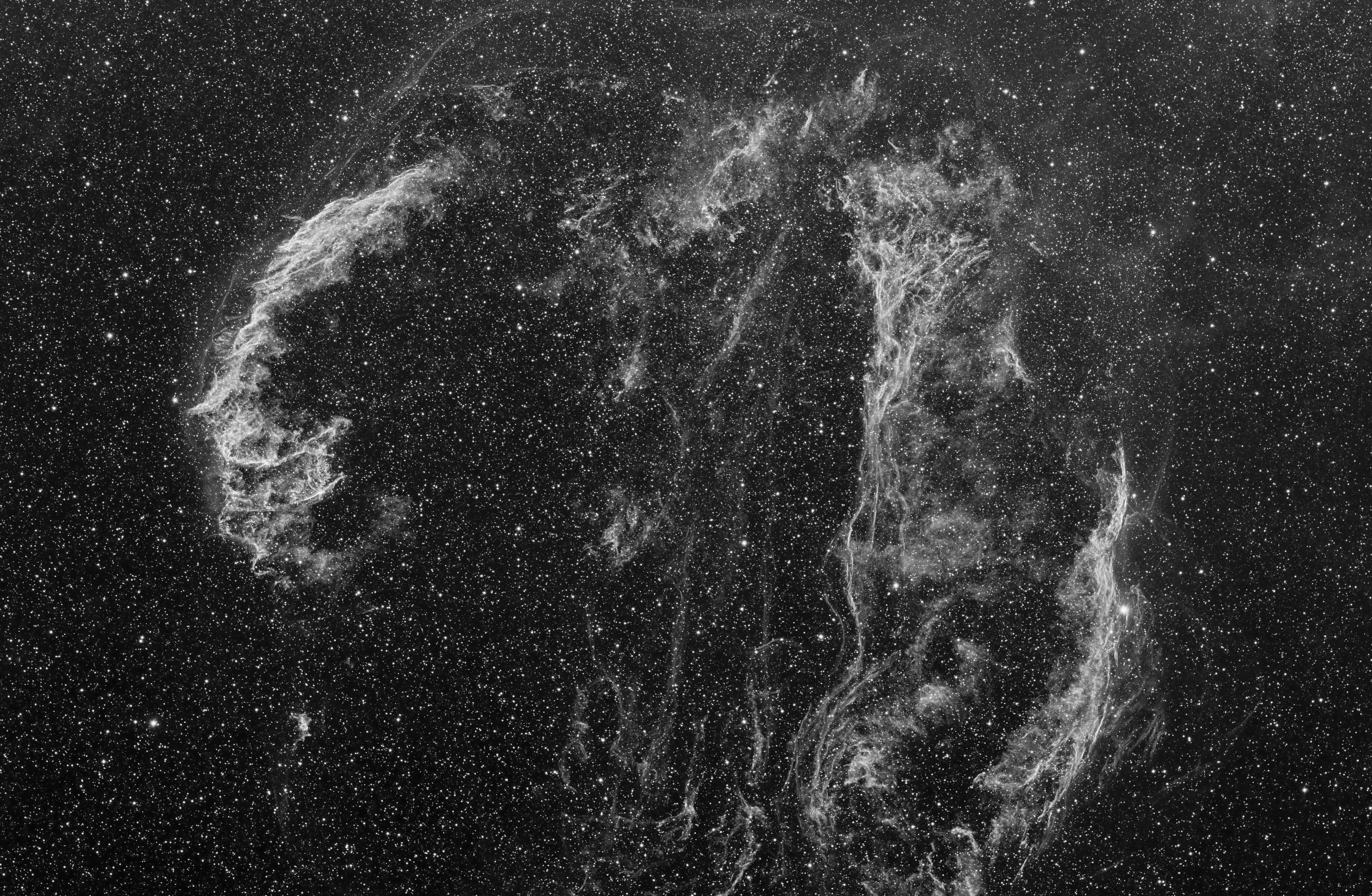
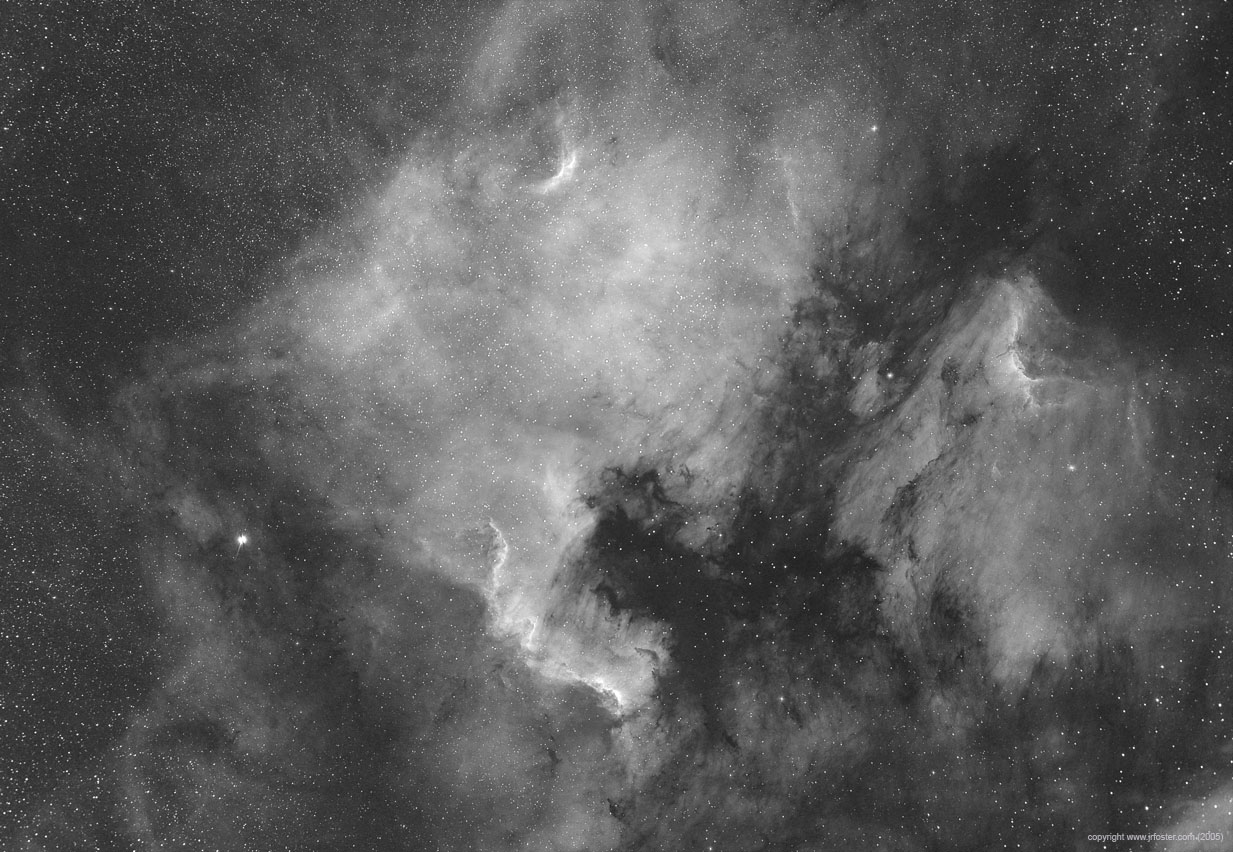
Binoculars with UHC and NPB on Veil, North American and Crescent. 15x50 stabilizers. The Veil looked very much like this photo in the binos - what a great view!


The North American stole the show in binoculars though, displaying its entire form, along with the Pelican Nebula, hands down the best view of this area I've ever seen. I swept over to the Crescent, which gave a nice view, but not comparable to that seen in a big Dob with a filter - and the entire Gamma Cygni area was filled with large clumps of glowing nebulae. Spectacular views in binoculars.


IC 469 07 55 59.1 85 09 32 V = 12.6; Size 2.2'x1.0'; Surf Br = 13.3; PA = 90d

18" 7mm- gives the impression of classic spiral galaxy tilted toward us, with mottled core area and possible sweeping arm in front, and large extended arms.


UGC 4078 = PGC 22640 08 04 24.7 84 38 29 V = 14.3; Size 2.1'x0.3'; Surf Br = 13.6; PA = 82d

18" 7mm - faint glow without central brightening. Three stars define the field, in a chain, bight and two dimmer, galaxy is off the side of center dimmer star. Galaxy seems to have hard edge or maybe dark lane on the side of the three stars. Very impressive maybe 6x1 ratio, and framed nicely in the center of three bright stars - bisecting them at a long angle.


CGCG 363-039 = PGC 23621 08 26 26.3 84 56 21 Size 1.0'x0.2'; PA = 130d

18" 7mm - this galaxy and one other small edge on proved to be the most challenging so far of the night - with only occasional "suspected" seeing a bit of it - a brightening between the two stars that flank it, and closer to the dimmer of the two.


UGC 4297 = PGC 23770 08 28 29.3 85 36 29 V = 13.6; Size 1.6'x0.4'; Surf Br = 12.9; PA = 83d

18" 7mm - bright,small, compact core with fleeting pinpoint nucleus. Core is uneven. Overall appearance is dim, but seems to have good extension, as does a dimmer elongated core.


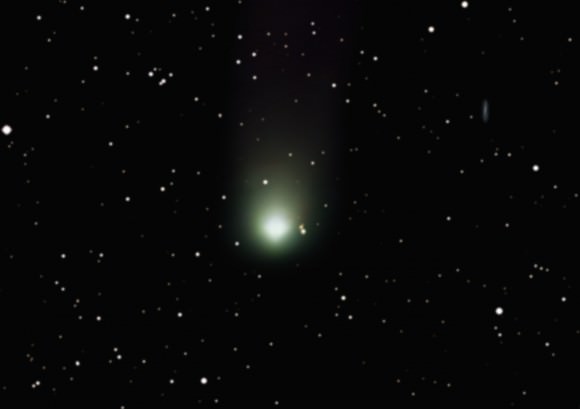
Comet in 6"refractor at low power- = bright comet, large even glow, core is tight with a very stellar nucleus.


CGCG 363-041 = PGC 23961 08 33 39.0 85 58 57 V = 14.4; Size 0.7'x0.6'; Surf Br = 12.9

18" 4mm - very dim but part of close pair. By comparison it is brighter and smaller with slightly oval shape pointing mostly away on its major axis form its partner.


UGC 4348 = PGC 24001 08 34 01.9 85 56 44 V = 14.2; Size 1.5'x1.2'; Surf Br = 14.7; PA = 21d

18" 4mm - part of pair, but larger the its companion by comparison, dimmer, separated by a definite black void.


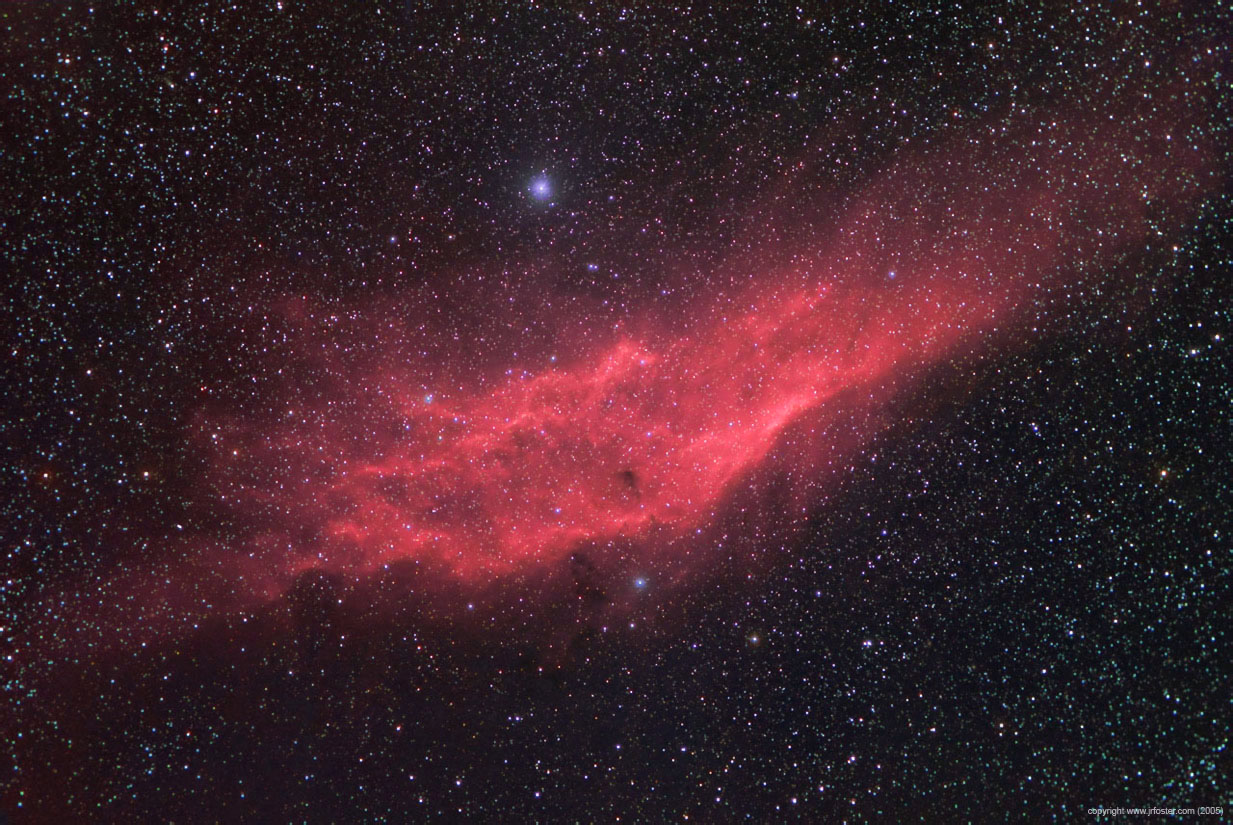
Thinking more about binocular views of the Veil and North American, I asked Steve about H-Beta filters. We came up with a pair, slapped them on, and easily found the California Nebula. The entire stretch of the object was visible, but of course it is quite tenuous, and while it did not have the "knock your eye out" impact of the others, there was no doubt we were seeing the entire target. Quite the sight.


IC 499 08 45 16.9 85 44 24 V = 12.5; Size 2.1'x1.1'; Surf Br = 13.2; PA = 80d

18" 4mm - very dim and ghostly, much like an unknown phosphorescent deep water creature who's insides show through a dim clear body. Not quite round, but not enough elongation to call it distinctly oval. Very dim star just to one side gives impression of almost an annular planetary nebula.


IC 512 = UGC 4646 = PGC 25451 09 03 49.8 85 30 06 V = 12.2; Size 1.8'x1.3'; Surf Br = 13.0; PA = 175d

18" 4mm - I've been galaxy hopping in this eyepiece, and the 7mm. This galaxy is quit4e dim., shape is indistinct. Sometimes it appears round with a sharp edge, other times it appears to extend in an amorphous shape. Amorphous extension turns out to be UGC 4612.